The Best Haircuts for a Long Face
Oleh Onysko 15 August 2026 7 min read

In this article
A long face, the oblong in face-shape charts, is longer than it is wide with fairly straight sides: forehead, cheeks and jaw all about the same width. Plenty of good faces are built this way. The styling question is balance, and unusually for hair advice, there is exactly one rule to learn.
First, confirm the shape
Hair fully back, photo straight on, camera at eye level. A long face measures clearly more than one and a half times longer than it is wide, and, unlike an oval, does not taper much: the sides run relatively straight from forehead to jaw. A taller forehead is common but not required.
If your length-to-width ratio is closer to 1.5 and your cheekbones are clearly the widest point, you are oval, and a different set of advice applies. If you are unsure which side of the line you fall on, a face shape analysis from one selfie settles it faster than the mirror will.
Worth saying plainly before the advice starts: a long face is not a flaw to be corrected. Plenty of models are built exactly this way. Balance is a preference, not a prescription, and the rule below is for people who want it.
Measure it instead of guessing
Both numbers in the same unit — the answer is a ratio, so it does not matter which.
Under 1.15 reads round, 1.15 to 1.5 reads oval, over 1.5 reads long. Oval and long split on the jaw rather than the ratio: an oval tapers towards the chin, a long face runs straight down.
The one rule: add width, never length
Every recommendation for a long face is this rule wearing different clothes. The face already has vertical distance; the job of the hair is horizontal interest. Volume at the sides rather than the top. Lines that cut across the face rather than run down it. Length that stops somewhere useful rather than dragging the eye further down.
Flip it for the warnings: anything that adds height at the crown, drags flat past the shoulders, or exposes the full run of the face at once is working against you. Keep the rule in mind and you can evaluate any style yourself without a chart.
Cuts that work: men's and shorter styles
For men the rule bites hardest at the top and sides. High volume on top with skin-tight sides is the current default at many barbershops, and on a long face it is a stretching machine: all height, no width. Ask instead for more length and texture left through the sides, a mid or low fade rather than a high one, and a top that sits forward or sweeps sideways rather than standing up.
Fringe-forward crops are quietly ideal, for reasons the fringe section below covers. Beards follow the same rule: fuller at the sides, shorter at the chin, since a long chin-heavy beard extends the face further. Run the candidates through a men's hairstyle try-on and the difference between a high and mid fade on this shape becomes obvious immediately.



Cuts that work: longer styles
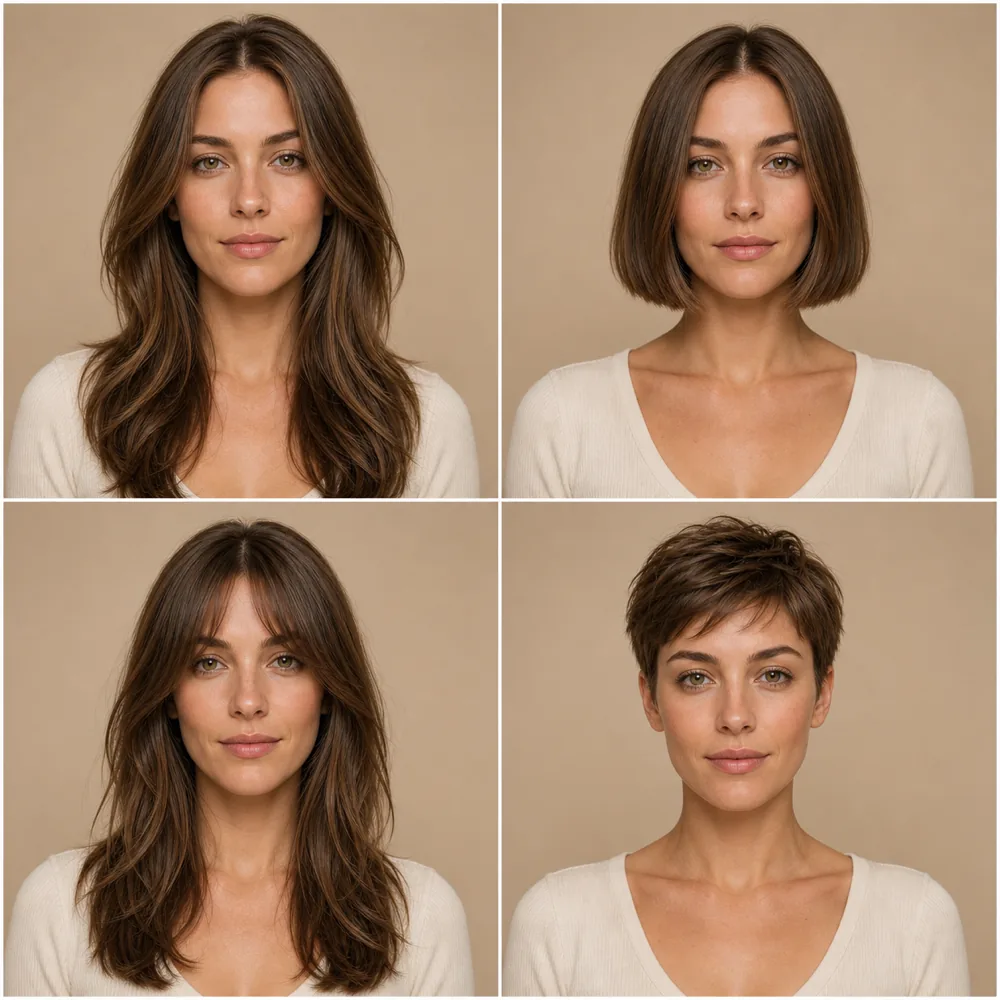
The reliable pattern is width at cheek or jaw level. Soft waves or curls starting around the cheekbone give the sides body exactly where the face is narrowest relative to its length. A shoulder-length cut with layers from the chin down does the same with less commitment. Bobs work well, from chin-grazing to collarbone, because the horizontal cut line breaks the vertical run of the face.
Partings matter more than people expect: a side parting introduces a diagonal, where a razor-straight centre parting on long straight hair adds a vertical seam down an already vertical face. That combination, dead-straight, centre-parted, past the shoulders, is the classic unflattering choice for this shape. See the alternatives on yourself with a women's hairstyle try-on rather than taking the chart's word for it.
Fringes are the cheat code
Nothing shortens a long face faster than a fringe, because it literally removes a stripe of visible face. A brow-grazing fringe can take several centimetres off the apparent length in one appointment, no surgery required.
The full blunt fringe is the strongest version, best on straight or gently waved hair. Curtain bangs are the softer option, better if you want movement or your hair resists sitting flat. Wispy, see-through fringes split the difference. The main mistake is a fringe cut too thin to register; on a long face it should be doing visible work. Audition all three versions on your own face with a bangs filter before you commit follicles to it.



What to avoid, and how to sanity-check
- Extra length without layers: a flat curtain of hair extends the vertical line.
- Height at the crown: quiffs, pompadours, top knots and beehive-adjacent volume all stretch the face.
- Scraped-back styles with no width: a tight ponytail or slick-back exposes the full length at once. If you like them, leave some softness at the sides.
- Chin-heavy beards on their own; balance them with side fullness.
Glasses, incidentally, work in your favour: a strong horizontal frame does a little of what a fringe does, breaking the vertical run of the face. They will not carry a bad haircut, but they can tip a borderline style into working on you when the chart says otherwise, which is exactly why testing beats theorising.
None of these are laws. They are defaults, and faces are more than one measurement. The honest sanity-check is visual: put the style on your own face and look. Twenty seconds per render, and the first look is free.
| Instinct | What it does to a long face | Do this instead |
|---|---|---|
| High volume on top, skin-tight sides | Adds height to a face already long | Mid or low fade, weight left in the sides |
| Dead-straight centre parting past the shoulders | A vertical seam down a vertical face | Side parting, layers from the chin down |
| Long one-length hair, no layers | Extends the vertical line | Waves or layers starting at the cheekbone |
| Tight ponytail or slick-back | Exposes the full run of the face at once | Leave softness at the sides |
| Long chin-heavy beard | Extends the face further down | Fuller at the sides, shorter at the chin |
Frequently asked questions
Anything that adds width rather than length. Volume through the sides, a mid or low fade rather than a high one, waves or curls starting around the cheekbone, bobs from chin-grazing to collarbone, and a side parting rather than a dead-straight centre one.
Height at the crown, so quiffs, pompadours and top knots. Extra length without layers, which extends the vertical line. And scraped-back styles that expose the whole run of the face at once. For men, high volume on top with skin-tight sides is a stretching machine.
They are the single most effective change, because a fringe literally removes a stripe of visible face. A brow-grazing fringe can take several centimetres off the apparent length in one appointment. The usual mistake is cutting it too thin to register.
Both are longer than they are wide, but a long face has fairly straight sides, with forehead, cheeks and jaw about the same width. An oval tapers towards the jaw, with the cheekbones clearly the widest point.
It follows the same rule as the hair: fuller at the sides, shorter at the chin. A long, chin-heavy beard extends the face further, so balance it with side fullness.
Share article
About the author
Founder & Editor
Founded Hairstyle Atlas after one bad clipper decision too many. Writes and edits the guides here, and tests every haircut on his own photo before recommending it.
More articles

Face Shapes · 5 min
What Haircut Suits a Heart-Shaped Face?
A heart-shaped face is widest at the forehead and narrowest at the chin. The cuts that balance that taper, and the ones that make the forehead the headline.

Face Shapes · 5 min
The Best Haircuts for a Square Face
A square face has a strong jaw and a forehead about the same width. The cuts that soften those corners, the ones that double them, and how to check the shape.
Face Shapes · 7 min
Do I Have a Round Face or an Oval Face?
Round and oval faces get confused constantly. Three quick measurements settle it for good, plus what the answer actually means for your next haircut.