Do I Have a Round Face or an Oval Face?
Oleh Onysko 15 August 2026 7 min read
In this article
Half the haircut advice on the internet begins with "if you have a round face" and never explains how to check. Round and oval are the two shapes people mix up most, because both are soft-edged, curved at the jaw and free of hard angles. The difference is not the outline. It is the proportions.
You can settle it in five minutes with a phone and a mirror. Here is how.
Why these two get confused
Square and heart-shaped faces announce themselves: a hard jaw corner, a pointed chin. Round and oval faces share the same soft geometry, so people default to whichever label they heard first, usually from a relative with opinions.
The actual difference is ratio. An oval face is noticeably longer than it is wide. A round face is close to as wide as it is long. Both curve at the jaw; the oval simply has more vertical distance to curve across. That single fact drives every styling recommendation that follows, which is why it is worth measuring rather than vibing.
The three measurements that settle it
Pull your hair fully off your face and take a photo, straight on, camera at eye level. Then compare three things, with a tape measure or honestly just by eye on the photo:
Length versus width
Measure hairline to chin, then cheekbone to cheekbone. Oval faces run roughly one and a half times longer than they are wide. Round faces are close to even, within about ten to fifteen per cent.
The widest point
Oval faces are widest at the cheekbones and taper gently towards the jaw. Round faces are widest at the cheeks and stay wide, with a full curve into the chin.
The forehead
On an oval face the forehead is a touch wider than the jaw. On a round face forehead and jaw are similar, both curved.
Two out of three decides it. Most people know within a minute of looking at the numbers instead of the mirror.
| What to compare | Oval | Round |
|---|---|---|
| Length vs width | About 1.5 times longer than wide | Within 10-15% of even |
| Widest point | Cheekbones, tapering to the jaw | Cheeks, staying wide into the chin |
| Forehead vs jaw | Forehead a touch wider | Much the same, both curved |
Measure it instead of guessing
Both numbers in the same unit — the answer is a ratio, so it does not matter which.
Under 1.15 reads round, 1.15 to 1.5 reads oval, over 1.5 reads long. Oval and long split on the jaw rather than the ratio: an oval tapers towards the chin, a long face runs straight down.
Two quicker tests, no tape measure required
The trace test. Take the straight-on photo, then trace the outline of your face on the screen with a finger, or in any drawing app. Seen as a pure outline, without features distracting you, round versus oval becomes obvious in a way it never is in the mirror.
The jaw test. Run a knuckle along your jaw from ear to chin. A continuous soft curve the whole way, with the face staying wide low down, points to round. A jaw that narrows steadily towards the chin points to oval. Cruder than measuring, but combined with the photo it rarely misleads.
One caution either way: hairstyles change the apparent shape. Volume at the sides reads rounder; height on top reads longer. That is exactly why the test photo needs the hair fully off the face, and why the same person can get two different labels from two different selfies.

If your face is round: what it changes
The classic goal for a round face is adding visible length. For men, that means height on top and tight sides: a crew cut with some lift, a brush-up, a low fade. For longer hair it means layers that start below the chin, a side or soft-centre parting, and a diagonal fringe line rather than a straight one; long curtain bangs work for exactly this reason.
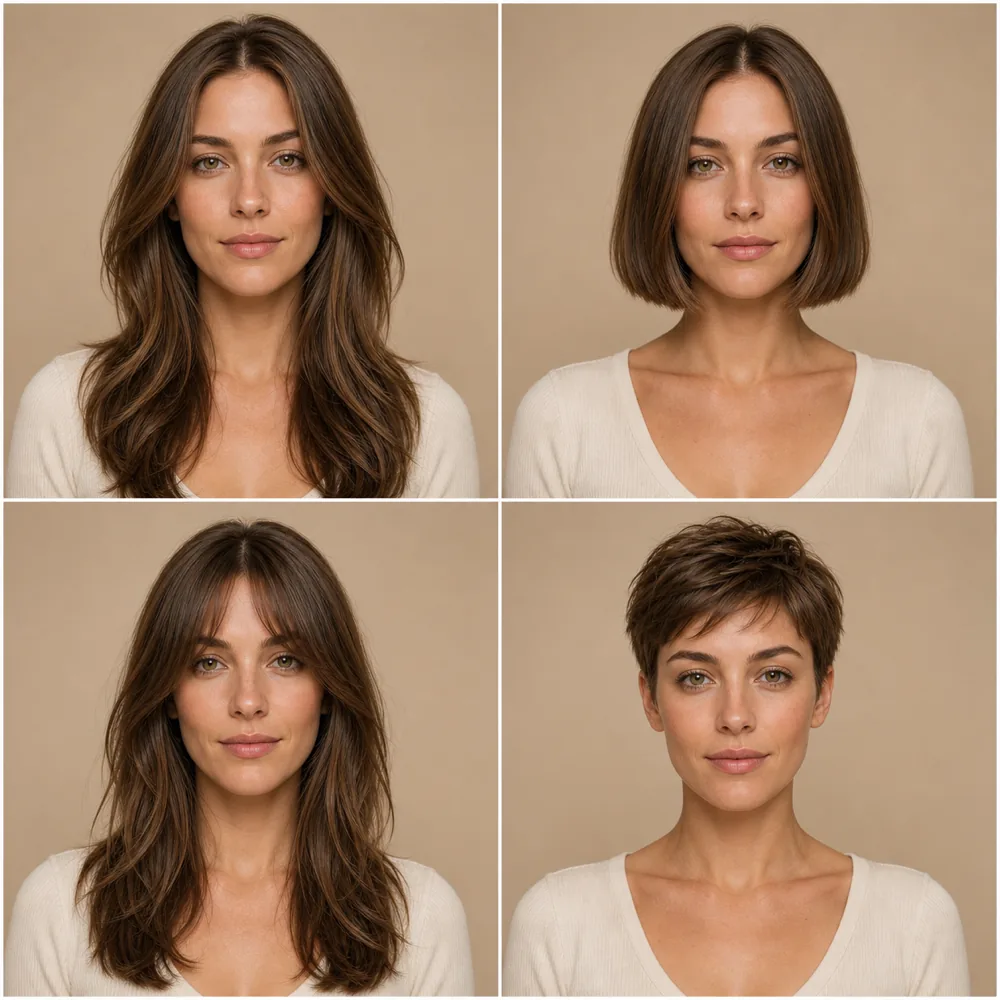
The usual caution is width at cheek level. A cut that ends at the widest point of the face, like a chin-length blunt bob, doubles down on the roundness. That does not ban bobs; it just moves them. A longer, angled bob that finishes below the jaw is one of the most flattering cuts on a round face, and you can check that claim on your own face with a bob haircut try-on in about twenty seconds.



If your face is oval: what it changes
An oval face is the shape most cuts were designed on, which means the face shape stops being the constraint. Buzz cuts, short crops, long layers, blunt bobs: structurally, they all work.
That is not the same as everything suiting you. With shape solved, the deciding factors become hair texture, density and how much styling you will actually do, and those rule out cuts just as firmly. The one caution worth keeping: a very heavy, brow-skimming fringe shortens an oval face towards round, which is fine if you want it and worth knowing if you do not. Oval-faced people should choose cuts for their hair, not their outline. It is the one shape where the interesting question moves entirely off the face and onto the head.
Still not sure? Measure with software, not squinting
Some faces genuinely sit between the two, and staring at your own reflection is a famously bad measuring instrument. Familiarity distorts judgement, and so does the slight tilt in every mirror selfie.
A what haircut suits me analysis maps your face from one straight-on selfie and classifies the shape from the same proportions described above, without the self-consciousness. Then the useful part: put a few recommended cuts on your actual face with a haircut simulator and compare. The label matters much less than what it looks like on you, and that part you can simply check.
Frequently asked questions
Proportion, not outline. Both curve softly at the jaw, but an oval face runs roughly one and a half times longer than it is wide, while a round face is close to as wide as it is long, within about ten to fifteen per cent.
Pull your hair fully off your face and take a straight-on photo with the camera at eye level, then compare three things: length versus width, where the face is widest, and whether the forehead is wider than the jaw. Two out of three decides it.
Anything that adds visible length. For men, height on top with tighter sides. For longer hair, layers starting below the chin, a side or soft-centre parting, and a diagonal fringe line rather than a straight one. A chin-length blunt bob ends at the widest point of the face, while a longer angled bob finishing below the jaw is one of the most flattering options.
Structurally, close to it, which really means the face shape stops being the constraint. Hair texture, density and how much styling you will actually do become the deciding factors instead. The one caution is a very heavy brow-skimming fringe, which shortens an oval face towards round.
Because hairstyles change the apparent shape: volume at the sides reads rounder, height on top reads longer. That is why the test photo needs your hair fully off your face and the camera at eye level.
Share article
About the author
Founder & Editor
Founded Hairstyle Atlas after one bad clipper decision too many. Writes and edits the guides here, and tests every haircut on his own photo before recommending it.
More articles

Face Shapes · 5 min
What Haircut Suits a Heart-Shaped Face?
A heart-shaped face is widest at the forehead and narrowest at the chin. The cuts that balance that taper, and the ones that make the forehead the headline.

Face Shapes · 5 min
The Best Haircuts for a Square Face
A square face has a strong jaw and a forehead about the same width. The cuts that soften those corners, the ones that double them, and how to check the shape.

Face Shapes · 7 min
The Best Haircuts for a Long Face
Long faces suit width, not more length. The cuts and fringes that balance an oblong face, and the popular styles that quietly make it look longer.