What Haircut Suits a Heart-Shaped Face?
Oleh Onysko 19 August 2026 5 min read

In this article
A heart-shaped face is wide at the forehead and cheekbones and tapers to a narrow, often pointed chin. Sometimes there is a widow's peak. The styling question is nearly always the same: add a little weight low down, and stop adding it at the top.
Confirming the shape
Hair fully back, straight-on photo at eye level. Three checks. Your forehead is the widest part of your face. Your jaw is clearly narrower than your cheekbones. And your chin comes to a point or a narrow curve rather than a corner.
The shape it is most often confused with is oval, which also tapers, but an oval is widest at the cheekbones rather than the forehead and is noticeably longer than it is wide. If the taper is the obvious feature and the length is not, you are in heart territory.
Measure it instead of guessing
Both numbers in the same unit — the answer is a ratio, so it does not matter which.
Under 1.15 reads round, 1.15 to 1.5 reads oval, over 1.5 reads long. Oval and long split on the jaw rather than the ratio: an oval tapers towards the chin, a long face runs straight down.
The rule: weight at the jaw, not at the crown
The face already narrows towards the bottom, so the job of the hair is to give the lower half something to balance the upper half with. Everything that works does one of two things: it adds visual width around the jaw, or it stops the forehead being the widest thing in the frame.
| Goal | What does it | What works against it |
|---|---|---|
| Balance a narrow chin | Length and body at or just below the jaw | Hair scraped back and up |
| Reduce forehead width | A soft fringe or side-swept pieces | A high, wide quiff or slicked-back top |
| Soften a pointed chin | Waves, curls, texture at the ends | Blunt ends that stop above the chin |
| Keep a widow's peak quiet | An off-centre parting | A dead-centre parting through the peak |
The cuts that do it
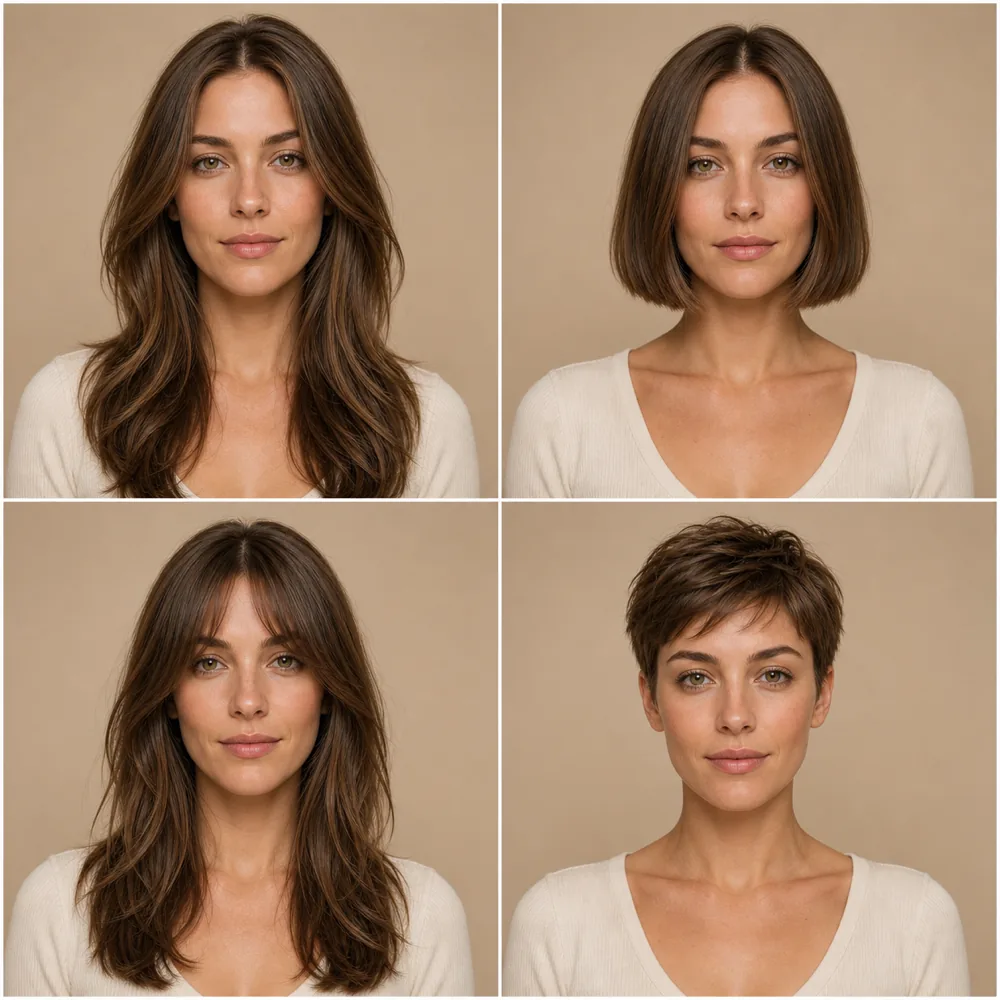
The reliable set is short: a chin- or collarbone-length cut with body at the ends, a stacked or rounded bob that puts volume at the back and sides, long layers starting around the jaw, and side-swept or curtain bangs to take some width off the forehead.




For men the same logic applies in a different vocabulary: a fringe-forward crop rather than height at the crown, and a beard is unusually useful here, because weight at the chin is the one thing this shape is short of.
What to be careful with
Three things, none of them bans. A very short pixie with all the volume on top puts the widest hair above the widest part of the face. A dead-centre parting draws a line straight through a widow's peak and emphasises the point of the chin below it. And hair pulled back tightly removes every bit of width from the jaw at once.
If you want any of them, the fix is usually small: leave softness at the temples, move the parting off-centre by a couple of centimetres, or let a few pieces fall at the jaw rather than scraping everything back.
Check it rather than trust the chart
Face-shape advice is a set of defaults, and defaults lose to hair type. Fine hair will not hold a stacked bob's volume without work; very thick hair may need weight removed from exactly the place the chart says to add it. Both of those override the shape.
So test the two or three candidates on your own face before booking. A women's hairstyle try-on renders them from one selfie, and the face shape analysis will settle the shape itself if you are still unsure which side of heart-versus-oval you fall on.
Frequently asked questions
Your forehead is the widest part of your face, your jaw is clearly narrower than your cheekbones, and your chin comes to a point or a narrow curve. A widow’s peak is common but not required.
Anything that adds weight around the jaw: a chin- or collarbone-length cut with body at the ends, a stacked or rounded bob, long layers starting at the jaw, and side-swept or curtain bangs to reduce forehead width.
A soft one, yes. Curtain bangs or side-swept pieces take width off the forehead without flattening it. A very heavy straight-across fringe can make the forehead the strongest horizontal in the face.
They can, but keep the volume off the very top. A pixie with all its height at the crown puts the widest hair above the widest part of the face, which doubles the taper instead of balancing it.
Where the face is widest. An oval is widest at the cheekbones and noticeably longer than it is wide; a heart is widest at the forehead, with the taper being the obvious feature rather than the length.
Share article
About the author
Founder & Editor
Founded Hairstyle Atlas after one bad clipper decision too many. Writes and edits the guides here, and tests every haircut on his own photo before recommending it.
More articles

Face Shapes · 5 min
The Best Haircuts for a Square Face
A square face has a strong jaw and a forehead about the same width. The cuts that soften those corners, the ones that double them, and how to check the shape.

Face Shapes · 7 min
The Best Haircuts for a Long Face
Long faces suit width, not more length. The cuts and fringes that balance an oblong face, and the popular styles that quietly make it look longer.
Face Shapes · 7 min
Do I Have a Round Face or an Oval Face?
Round and oval faces get confused constantly. Three quick measurements settle it for good, plus what the answer actually means for your next haircut.