History, technique, and costume notes
1990s Hairstyles
Layered blowouts and sleek bobs meet braids, curtains, and sculpted fades.
How to cite this page
HairstyleAtlas. “1990s Hairstyles.” https://hairstyleatlas.com/historical-hairstyles/1990s. Accessed October 20, 2026.
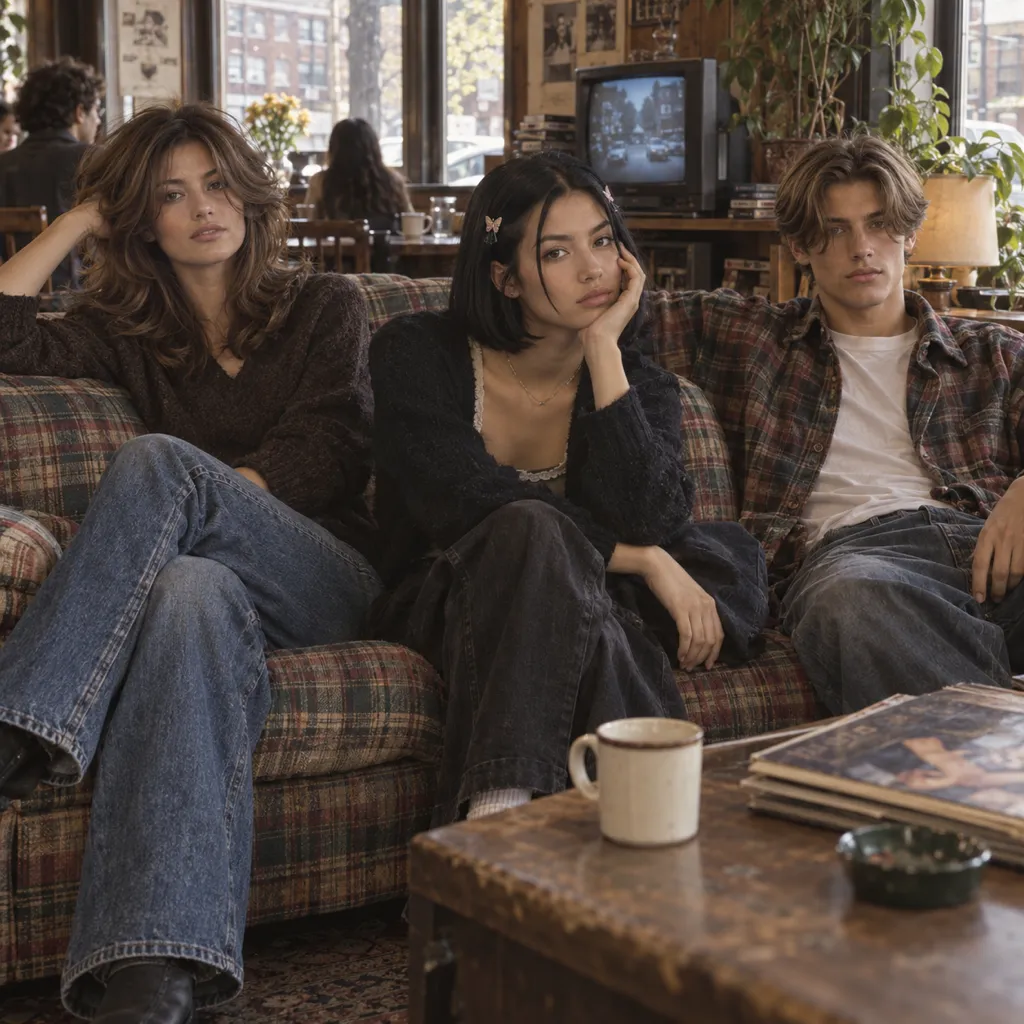
Hair in the 1990s
The 1990s brought contrasting ideals into the same visual field: glossy layered hair, deliberately casual grunge textures, sleek short cuts, braids, and carefully sculpted barber styles. Television, music videos, magazines, and youth scenes circulated looks quickly, but fashion did not move in one direction. A polished blowout and an apparently unstyled long cut might be worn by people of the same age in the same city.
For costume research, the decade is especially vulnerable to modern nostalgia that mixes early- and late-decade details. High tops carried over from the late 1980s, while curtain cuts and face-framing layers changed proportions over time. Box braids belonged to much longer Black hair traditions, even as contemporary popular culture increased their visibility. Identify the scene’s year and community, then examine the part, perimeter, texture, accessories, and finish separately before assembling the final design.
Women’s signature styles
Layered blowout
Face-framing layers and a full, smooth blowout became recognizable features of 1990s screen and salon imagery. Shorter sections around the cheeks blended into a longer lower outline. Similar names are now used for many revived cuts, so the shape should be checked against an actual period photograph.
How it was done: The haircut distributed weight through graduated layers. A blow-dryer and round brush lifted the roots and bent the ends, with mousse or another styling preparation supplying body. The finished hair looked mobile and separated into broad sections rather than forming one solid helmet of volume.
Recreating it for stage & costume: Use a layered wig with sufficient density at the front to form the face-framing shape. Dry or set sections in the intended direction and allow them to cool. Avoid substituting current long curtain bangs for every 1990s layered cut; compare the shortest layer, overall length, and degree of root lift.
Box braids
Box braids were highly visible in 1990s Black popular culture while drawing on much older braiding practices. Individual braids could be worn loose, gathered, or arranged into other styles. Their appearance in a music video or film did not mark the invention of the technique.
How it was done: Hair was divided into individual sections, often with a box-like pattern at the scalp, and each section was braided along its length. Added hair could supply length or fullness. Size, length, and finish varied, and the work required planning, skilled handling, and time.
Recreating it for stage & costume: Consult a braider and the performer about a suitable construction and maintenance plan. Match braid size and scalp pattern to the reference, and avoid unnecessary weight or tension. A prepared wig may suit repeated changes, but its hairline and sectioning pattern need as much attention as the visible braid lengths.
Sleek bob
A clean bob offered a compact alternative to layered fullness and longer casual hair. It could be center-parted, side-parted, tucked behind the ears, or finished with small clips. These differences help locate a particular character more precisely than the broad label bob alone.
How it was done: Scissor cutting established a clear perimeter with enough weight to hold the outline. Blow-drying with a brush smoothed the surface and directed the ends. Finishing products controlled flyaways; the amount of bend could range from nearly straight to a soft inward curve.
Recreating it for stage & costume: Fit the length to the reference and check whether the ends stop at the jaw or below it. Use accessories sparingly and date them separately instead of adding every nostalgic clip style at once. On a wig, make the visible part and ear tuck believable before concentrating on surface shine.
Men’s signature styles
Curtains
Curtain styles divided longer front sections around a central or near-central part. They appeared in several youth and entertainment settings, from smooth pop imagery to looser casual looks. Side length, weight, and texture varied, so the style was not one fixed haircut worn identically throughout the decade.
How it was done: The top and front were left long enough to fall to either side, with the lower sections shaped to suit the cut. A brush and dryer could create root lift or a slight outward bend. Lighter styling products maintained movement, while a flatter finish emphasized the divided front.
Recreating it for stage & costume: Choose the part position and front length from a period reference. Keep a wig from looking like two rigid panels by allowing natural separation and movement. If the character wears a cap, test how the front resets afterward and record whether the intended finish is smooth, waved, or casually disordered.
High-top fade and shorter shaped variants
The high-top fade continued into the early 1990s, alongside a wider range of shorter and differently shaped cuts. Black barbershops and music culture gave these silhouettes strong visibility. It is important to distinguish a tall early-decade reference from a later or more restrained version.
How it was done: Clippers controlled the graduation at the sides and back, while the coiled top was picked and shaped. Edge work clarified the perimeter and hairline. The height and upper contour were design choices, not automatic consequences of the wearer’s texture.
Recreating it for stage & costume: Use a barber familiar with the texture and preserve the intended proportions over the run. If a wig is necessary, check the transition from exposed skin to the fuller top from several angles. Avoid replacing every period fade with a current barber trend merely because both use close sides.
Short crop and Caesar-style front
Short cuts with a forward-directed top offered a compact alternative to curtains and longer grunge-associated hair. A Caesar-style version used a short horizontal line of bangs. Similar cuts have a much longer history, so their presence in the 1990s should be described as a contemporary choice rather than a new invention.
How it was done: Clippers and scissors reduced the sides and shaped a short top that could be brushed forward. Gel or another holding product defined the direction and separated the surface when desired. The bangs were cut to a deliberate length instead of being formed by combing an unrelated longer style over the forehead.
Recreating it for stage & costume: Keep the front line appropriate to the reference and avoid an overly sharp modern crop if the character’s look is softer. Use a small amount of product to maintain direction. Photograph the profile and crown, since an otherwise convincing front can hide a contemporary fade or an incorrect weight distribution.
Notable products & tools
- Blow-dryers, round brushes, mousse, gel, and smoothing products supported contrasting finishes, from full layered movement to a compact bob or divided curtain front.
- Sectioning combs and braiding skill built individual braids; clippers and picks shaped fades. A practical costume plan includes fitting and maintenance time as well as the initial styling session.
Regional & cultural variations
Minimalist fashion, grunge, hip-hop, pop performance, and local everyday dress offered different ideas of polish and identity. Cornrows, locs, natural hair, and many other styles also belong to the decade, even where this short selection cannot cover them fully. Gendered sections organize the reference rather than restrict who wore a look. Compare local photographs with fashion imagery and treat the year, community, and wearer’s own choices as essential evidence.
See it on your own face
Try a hairstyle free with one selfie. Explore a modern interpretation of a cut; the preview is a starting point for your design, not a historical reconstruction.
Sources & further reading
These museum, archive, library, and editorial resources provide historical context and further research. The stage and costume suggestions above are modern interpretations. Consult dated images for a specific year, place, and wearer.
- 1990-1999. Fashion History Timeline (FIT). https://fashionhistory.fitnyc.edu/1990-1999/
Overview essay on 1990s fashion, from minimalism and grunge to hip-hop style.
- A 1990s Fashion History Lesson: Supermodels, Grunge, and the Dawn of the Digital Age. Vogue. https://www.vogue.com/article/90s-fashion-history
Vogue's survey of 1990s style, covering supermodels, grunge, minimalism and hip-hop.
- Reinvention & Restlessness: Fashion in the Nineties. The Museum at FIT. https://www.fitnyc.edu/museum/exhibitions/fashion-in-the-nineties.php
Museum at FIT exhibition page on eight trends that defined 1990s fashion, with curatorial texts and object images.
- Reinvention and Restlessness: Fashion in the Nineties Symposium. The Museum at FIT. https://www.fitnyc.edu/museum/events/symposium/90s/index.php
Recorded talks by curators and scholars on 1990s fashion, from globalism to technology.
- Alexander McQueen – an introduction. Victoria and Albert Museum (V&A). https://www.vam.ac.uk/articles/alexander-mcqueen-an-introduction
V&A introduction to McQueen, whose 1990s shows defined avant-garde British fashion of the decade.