History, technique, and costume notes
1980s Hairstyles
Big texture, sharply different lengths, and sculpted silhouettes.
How to cite this page
HairstyleAtlas. “1980s Hairstyles.” https://hairstyleatlas.com/historical-hairstyles/1980s. Accessed October 20, 2026.
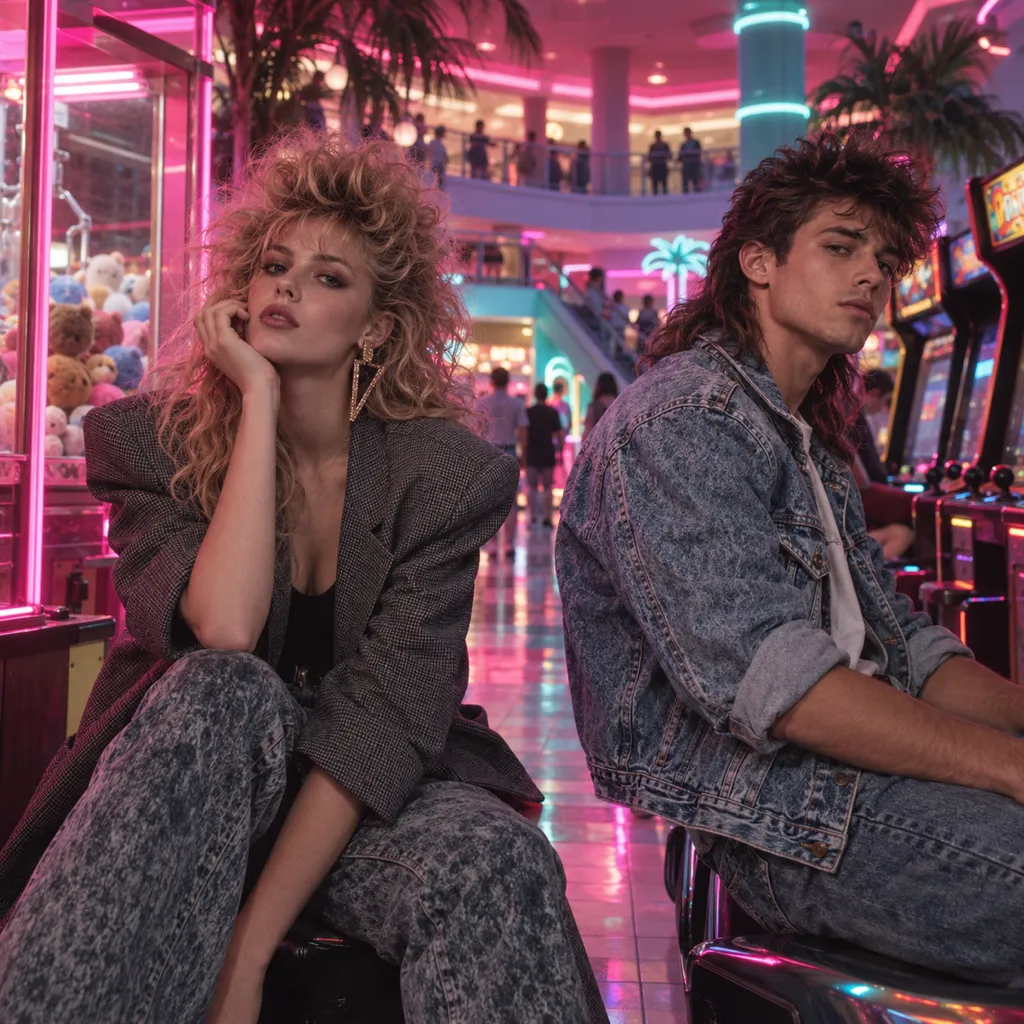
Hair in the 1980s
The familiar phrase big hair describes only part of the 1980s. Permed volume, teased bangs, sculpted short cuts, mullets, and precise fades belonged to different wardrobes and social scenes. Music videos and fashion media made contrasting silhouettes highly visible. A broad shoulder line in clothing could be balanced by fuller hair, but a smooth office bob or a close barber cut could be just as plausible for a particular character.
Technology and products offered several routes to texture: chemical permanent waving, crimping, roller setting, blow-drying, and backcombing produced distinct effects. Black salons and barbershops developed their own highly visible looks, including sculpted high tops and chemically formed curls. Do not combine every recognizable feature into one costume. Establish whether the scene belongs to the early or late decade, identify its community and activity, and choose a coherent combination of cut, texture, and finish.
Women’s signature styles
Permed volume
Permanent waving offered lasting curl or body that could be dressed into a full silhouette. Not all large 1980s hair was permed, and not all perms produced tight curls. The cut, rod size, and subsequent styling shaped the result as much as the general label perm.
How it was done: Hair was wound around rods and chemically processed to establish a new curl pattern, then rinsed and neutralized according to the system. Daily styling could use mousse, scrunching, diffused drying, or brushing. Layers and root lift helped distribute the volume rather than leaving a heavy triangular outline.
Recreating it for stage & costume: For a production, use a textured wig or temporary set instead of asking an actor to undergo chemical processing. Choose the curl scale from a dated reference. Build volume where the photograph shows it, and test whether the texture remains readable under stage lighting without excessive teasing or product buildup.
Raised bangs and crimped lengths
Lifted front sections and deliberately textured lengths appeared in many youth and performance looks. Crimping made a repeated angular pattern, different from a natural curl or a rod perm. These techniques could be combined, but neither was a requirement for all fashionable women in the decade.
How it was done: A crimping iron pressed a zigzag texture into sections, while a dryer, brush, or heated tool directed the bangs upward. Backcombing created additional support and hairspray held the arrangement. The front and lower lengths were often worked separately to give each area its intended shape.
Recreating it for stage & costume: Use only tools suitable for the wig fiber and prepare test sections before styling the whole piece. Keep the height and crimp density close to the reference. A supported front section can survive repeated shows more reliably than adding fresh layers of spray every night until the hair becomes rigid.
Asymmetric short cut
Asymmetric cuts offered a graphic alternative to all-over fullness. One side could be longer, the front swept diagonally, or the upper sections sharply directed. Club and New Wave imagery helped circulate these forms, though the term covers many different cuts rather than one standard pattern.
How it was done: Scissor and sometimes clipper work established the contrast between lengths. Blow-drying directed the longer sections, while gel, mousse, or spray controlled the surface. Color could reinforce the design, but a dramatic dye treatment was not necessary for an asymmetric outline to register.
Recreating it for stage & costume: Select one documented shape and build its asymmetry deliberately. Avoid combining a modern undercut, contemporary color placement, and unrelated period accessories without evidence. Check the performer’s sightline and microphone placement early, particularly if the long front crosses an eye or the shorter side exposes the ear.
Men’s signature styles
Mullet
Shorter front and side sections combined with a longer back became a recognizable 1980s silhouette, with roots in earlier popular styles. The familiar name mullet became widely established later, so it should not be treated as the universal contemporary label. Versions ranged from restrained to dramatically long and textured.
How it was done: The cut preserved length at the nape while reducing the sides and shaping the top. The longer sections might be straight, naturally wavy, or permed. Blow-drying, mousse, gel, and spray could create lift and separation, depending on the desired finish.
Recreating it for stage & costume: Match the relationship between top, sides, and back rather than simply attaching a long tail. A modern burst fade changes the effect and should be used only if supported by the reference. For a wig, blend the transition into the nape so the extra length moves convincingly during performance.
High-top fade
The high-top fade became especially visible in later-1980s Black youth and music culture. Tall coiled hair above closely tapered sides created a clear contrast in shape and texture. Heights, upper contours, and details varied; the cut should not be assigned indiscriminately to every year of the decade.
How it was done: The top was grown and shaped while the sides and back were progressively shortened. Picking and careful clipper work established the outline, with the hairline finished to suit the design. The upper surface could be squared or adapted into other sculpted forms.
Recreating it for stage & costume: Work with a barber experienced in coiled hair and choose a reference from the correct year. A wig must reproduce the texture and the transition at the sides, not just the tall silhouette. Plan maintenance during the run, since a small change at the perimeter can visibly soften a precise geometric shape.
Jheri curl and similar curl systems
The Jheri curl was a chemically created curl style associated with the late twentieth century and especially visible in 1980s popular culture. Men and women wore related curl treatments. It should be distinguished from an untreated natural curl pattern and from a conventional perm performed on straighter hair.
How it was done: A salon process reshaped the hair into a looser curl pattern using the appropriate chemical system and rods. Maintenance products helped keep the curls supple and defined. The characteristic moist-looking finish was part of the grooming routine, not proof that the hair was simply left wet after washing.
Recreating it for stage & costume: Recreate the visual effect with a suitable curled wig and a fiber-compatible finish rather than reproducing the chemical service on a performer. Test shine under the actual lighting and keep costume collars protected from transferable products. Use references of the intended wearer and setting instead of exaggerating the look for comic effect.
Notable products & tools
- Perm rods, crimping irons, blow-dryers, mousse, gel, and hairspray served different kinds of texture. A crimped angular pattern should remain distinct from a rounded curl in a close-up design.
- Clippers and picks shaped high tops; curl-maintenance products served chemically formed curls. Chemical systems are historical context here, not instructions for an unsupervised backstage treatment.
Regional & cultural variations
New Romantic clubs, rock audiences, hip-hop scenes, offices, and family life produced overlapping but distinct styles. The decade’s fashion imagery often amplifies conspicuous volume while overlooking restrained everyday grooming. Black hairstyles also crossed gender boundaries, and a late-decade high top should not stand in for an early-decade setting. Use local and dated evidence to decide which elements belong together, and keep a record of the reference behind each character’s design.
See it on your own face
Try a hairstyle free with one selfie. Explore a modern interpretation of a cut; the preview is a starting point for your design, not a historical reconstruction.
Sources & further reading
These museum, archive, library, and editorial resources provide historical context and further research. The stage and costume suggestions above are modern interpretations. Consult dated images for a specific year, place, and wearer.
- 1980-1989. Fashion History Timeline (FIT). https://fashionhistory.fitnyc.edu/1980-1989/
Overview essay on 1980s fashion, from power dressing to club and street style.
- A 1980s Fashion History Lesson: Lycra, Power Suits, and Clothing as Concept. Vogue. https://www.vogue.com/article/1980s-fashion-history-lesson
Vogue's survey of 1980s style, from power suits and Lycra to the New Romantics.
- Back to the 80s. Fashion History Museum (Cambridge, Ontario) via Google Arts & Culture. https://artsandculture.google.com/story/back-to-the-80s-fashion-history-museum-cambridge-ontario-canada/OwUhNc1BH4q-IQ?hl=en
Museum story on 1980s dress, including New Wave and New Romantic looks with frilled shirts and coloured hair.
- Vivienne Westwood: punk, new romantic and beyond. Victoria and Albert Museum (V&A). https://www.vam.ac.uk/articles/vivienne-westwood-punk-new-romantic-and-beyond
V&A article tracing Westwood's work from 1970s punk to the New Romantic and mid-1980s collections.
- Your mullet is more than a haircut, it's a political statement – a hair historian explains. The Conversation. https://theconversation.com/your-mullet-is-more-than-a-haircut-its-a-political-statement-a-hair-historian-explains-203973
A hair historian on the mullet's history and its 1970s–80s rock and punk associations.