History, technique, and costume notes
1940s Hairstyles
Rolls and brushed curls meet the practical demands of wartime work.
How to cite this page
HairstyleAtlas. “1940s Hairstyles.” https://hairstyleatlas.com/historical-hairstyles/1940s. Accessed October 20, 2026.
Hair in the 1940s
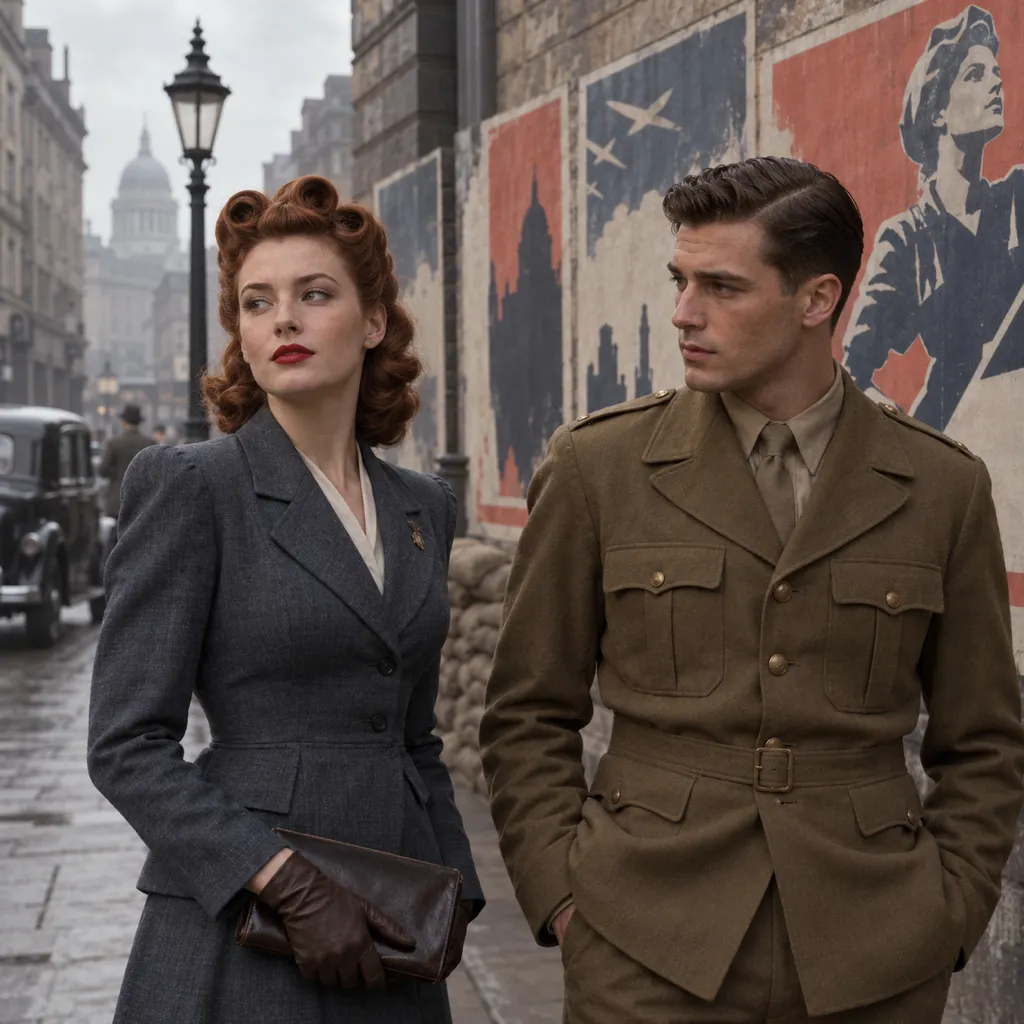
War changed the practical demands placed on hair without eliminating fashion. Women working in factories needed to contain loose lengths; service uniforms brought grooming requirements; scarcity affected what could be bought and how often it was replaced. Hair could offer visible variety when clothing choices were restricted. The familiar combination of raised front sections and curled ends is useful for a 1940s silhouette, but elaborate rolls were not the universal hairstyle of working women.
Much of the shape began with a wet set. Pin curls gave hair direction and spring before brushing, rolling, or gathering it into a net. Men’s short military haircuts existed alongside civilian styles with longer, dressed tops. The decade also includes a postwar shift in fashion, so a costume set in 1948 should not automatically repeat a factory-worker image from the middle of the war. Use the sources below to establish the setting before choosing a recognizable silhouette.
Women’s signature styles
Raised rolls and victory rolls
Rolled sections around the forehead are strongly associated with 1940s hair. Contemporary arrangements varied in number, placement, and size; the large symmetrical pair familiar from modern vintage styling is only one interpretation. The term victory rolls should not be used to invent a single wartime origin story for every rolled style.
How it was done: A pin-curl set gave the hair enough bend to roll smoothly. Front or side sections were brushed, lifted, turned inward, and secured with pins, while the remaining hair could be curled or gathered. The structure came from the set, careful sectioning, and secure anchoring rather than from a modern high-shine gel shell.
Recreating it for stage & costume: Practice the rolls over a prepared set instead of attempting them on slippery, freshly straightened hair. A small removable support can help a wig keep its outline during a long run. Check the silhouette with the character’s hat and choose roll size from the reference, not from a generic retro-party image.
Pageboy and brushed-under ends
The pageboy offered a smooth upper surface and an organized inward turn at the ends. Versions ranged from shorter arrangements to lengths around the shoulders. It could look restrained or glamorous depending on the front wave and the amount of fullness around the face.
How it was done: The hair was set so that the lower sections would turn in a common direction. After drying, brushing joined the curls into a continuous roll rather than leaving them as individual ringlets. Setting lotion and a hair net could help preserve the dressed shape between the initial set and the occasion.
Recreating it for stage & costume: Use a wig with sufficient length at the perimeter to make a unified turn. Brush the ends over your hand, then support the curve with clips while it settles. Test the finished style with coats and collars, which can turn a neat pageboy into an accidental outward flip during movement.
Snood or scarf with a dressed front
Snoods gathered longer hair in a net, while scarves could cover or restrain it for work. They also appeared as fashion accessories, so their meaning depended on the setting. A decorative open net and an effective workplace covering were not necessarily the same thing.
How it was done: The front could be waved or rolled, with the remaining length gathered into a snood at the back. A scarf was folded and tied to contain the hair according to the task. Pins and a stable base helped prevent the covering from sliding off during wear.
Recreating it for stage & costume: For a scene involving machinery, follow the production’s actual safety requirements as well as its visual research. Fit the snood to the amount of hair instead of leaving an empty pouch. Rehearse bending and quick changes, and keep the tie or fastening away from microphones and costume closures.
Men’s signature styles
Short military cut
Military service made short, manageable cuts a conspicuous part of the decade. Exact standards differed between forces, units, and circumstances. A single modern buzz cut should not be used as a universal substitute for every serviceman’s appearance in every theater of war.
How it was done: Clippers and scissors shortened the back and sides, with the top adjusted to the required regulation and the wearer’s hair. A little grooming preparation might control a longer top. Maintenance depended on access to a barber, so photographs from active service can differ from formal recruitment portraits.
Recreating it for stage & costume: Consult a dated image of the relevant service and unit before deciding clipper lengths. A subtle taper often reads more convincingly than an extremely crisp contemporary fade. If the actor cannot cut their hair, discuss a short wig early, because an exposed hairline needs careful fitting.
Civilian side part
Civilian men continued to wear side-parted hair with neatly trimmed sides. This adaptable arrangement could suit office work, formal occasions, and daily life. Wartime context did not mean that every man wore uniform or immediately adopted a military-length haircut.
How it was done: The top was left long enough to comb across from a part, while the nape and sides were tapered. Grooming cream or pomade supplied hold and a controlled sheen. The front could be brushed slightly upward without creating a large sculptural shape.
Recreating it for stage & costume: Keep the part natural and the finish appropriate to the scene. A light dressing is easier to reset between performances than a thick layer of hardened gel. Compare the haircut with the collar and hat brim, and preserve a consistent outline in continuity photographs taken from both sides.
Longer brushed-back wave
Some civilian and entertainment looks retained more length and a pronounced wave above the forehead. Such styling could suggest leisure or a more fashionable character without becoming the exaggerated pompadour of later popular imagery. The surrounding clothes and setting remain essential to reading it correctly.
How it was done: A longer front was combed upward and back, using natural wave or a prepared set to establish the bend. Dressing helped unite the surface, and the sides were directed back toward the nape. The silhouette relied on top length, not simply on coating short hair with product.
Recreating it for stage & costume: Create the basic direction with a controlled blow-dry or temporary set, then finish with a small amount of pomade. Keep the lift low enough to match your source. A modern disconnected undercut changes the silhouette, so blend the sides or select a wig that carries the appropriate fullness.
Notable products & tools
- Pin curls, setting lotion, hairpins, and nets formed a versatile kit for waved fronts, rolls, and brushed-under ends. A single set could be dressed in several ways.
- Combs, clippers, and grooming creams maintained men’s shapes. Scarves and snoods could contain longer hair, but decorative accessories should not be mistaken for modern protective equipment.
Regional & cultural variations
British rationing, American factory work, civilian life under occupation, and military service created very different conditions. Black women’s salon and home grooming practices also continued within unequal social and working environments. Do not imply that one US wartime poster describes all women. For a specific production, compare its location, class, occupation, and year with local images; distinguish a morale-building publicity photograph from a record of daily work.
See it on your own face
Try a hairstyle free with one selfie. Explore a modern interpretation of a cut; the preview is a starting point for your design, not a historical reconstruction.
Sources & further reading
These museum, archive, library, and editorial resources provide historical context and further research. The stage and costume suggestions above are modern interpretations. Consult dated images for a specific year, place, and wearer.
- 1940-1949. Fashion History Timeline (FIT). https://fashionhistory.fitnyc.edu/1940-1949/
Overview essay on 1940s dress, from wartime Utility clothing to Dior's 1947 New Look.
- A 1940s Fashion History Lesson: Wartime Utility Suits, the New Look, and More Trends of the Decade. Vogue. https://www.vogue.com/article/1940s-fashion-history-lesson
Vogue's survey of 1940s style, from make-do-and-mend wartime dressing to the postwar New Look.
- Wartime Wardrobes. English Heritage. https://www.english-heritage.org.uk/visit/inspire-me/wartime-wardrobes-1940s-fashion-rationing/
Historian Julie Summers on clothes rationing in 1940s Britain and what it reveals about style and society.
- It's Your War, Too: Women in World War II. The National WWII Museum. https://www.nationalww2museum.org/war/articles/its-your-war-too-women-world-war-ii
Museum article on women in wartime service, including the grooming rules and the encouragement of makeup and feminine hairstyles.
- Fashion on the Ration: The story of clothing on the home front during World War Two. Museum Crush. https://museumcrush.org/fashion-on-the-ration-the-story-of-clothing-on-the-home-front-during-world-war-two/
Museum-sector feature on rationing, Utility clothing and make-do-and-mend on the British home front.