History, technique, and costume notes
1950s Hairstyles
Salon polish and sculpted curls share the decade with teenage ponytails and quiffs.
How to cite this page
HairstyleAtlas. “1950s Hairstyles.” https://hairstyleatlas.com/historical-hairstyles/1950s. Accessed October 20, 2026.
Hair in the 1950s
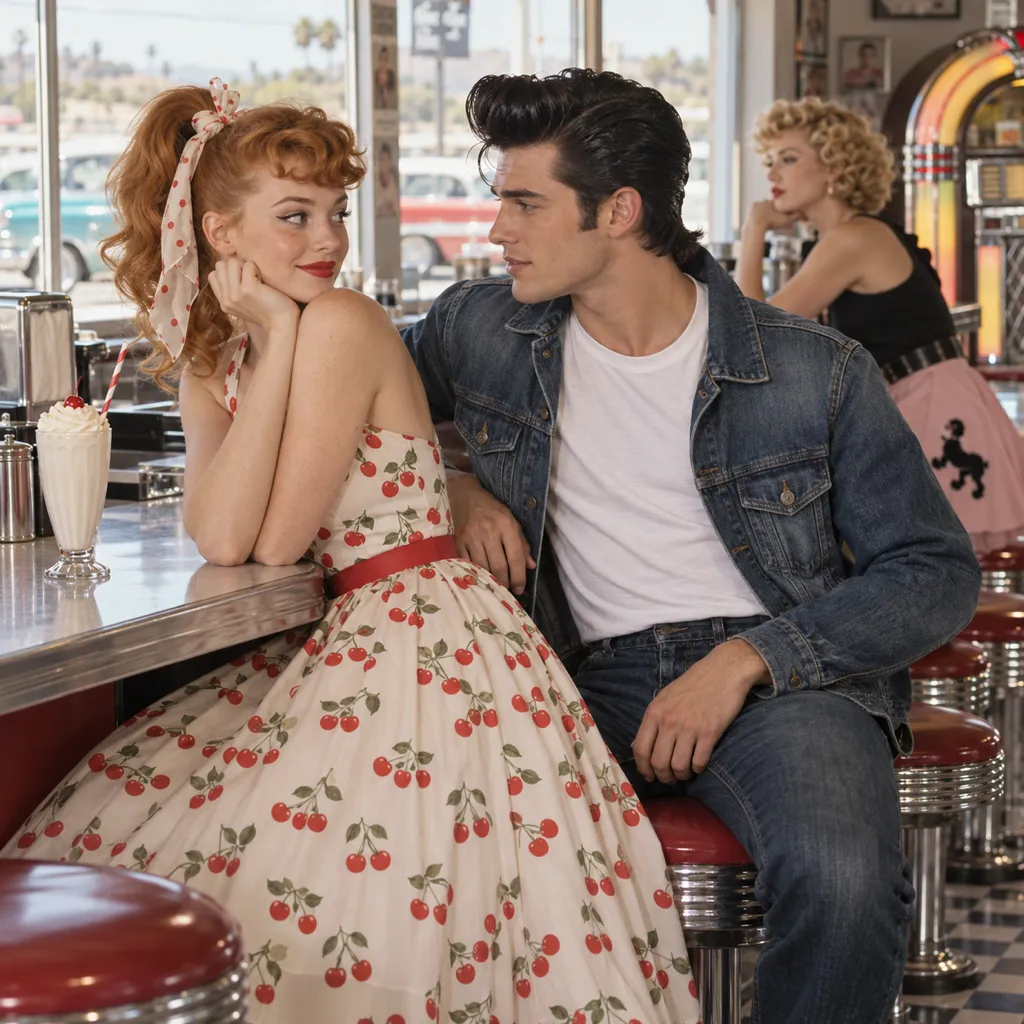
The 1950s placed highly groomed hair beside an increasingly visible youth culture. Fashion photography promoted coordinated clothes, accessories, and carefully finished hair, while teenagers developed their own associations around music, movies, and leisure. Neither a ponytail nor a pompadour belonged to every young person. Short practical cuts and familiar side parts remained common, and the polished appearance of a salon set could require substantial work at home between appointments.
For women, the cut often served a setting pattern rather than determining the final silhouette by itself. Pin curls, rollers, permanent waving, and brushing could turn relatively short hair into a rounded mass of curls. Men’s more conspicuous styles used top length and dressing to lift or sweep the front. Choose the character’s age, social setting, and point within the decade before borrowing a familiar image of a diner, a couture salon, or a rock-and-roll stage.
Women’s signature styles
Short curled set
A short, full arrangement of curls offered a polished outline around the face. The curls could be compact and clearly defined or brushed into a softer rounded shape. Modern labels such as poodle cut describe part of this range but should not erase the differences visible in individual references.
How it was done: A shaped haircut supplied manageable lengths, and pin curls or rollers established the curl pattern. A permanent could add a lasting foundation. Once dry, the hair was brushed or arranged into the desired fullness, then controlled with setting products or spray as needed.
Recreating it for stage & costume: Set a short wig with varied curl directions around the hairline rather than making every roller identical. Brush cautiously: too little leaves obvious set marks, while too much can create a shapeless halo. Fit small hats and decorative clips after the final shape is established, and record their anchor points.
Ponytail with a dressed front
The ponytail became a recognizable element of youthful, informal 1950s styling. It could be worn with bangs, a smooth front, or a deliberately curled section. Its association with teenagers does not mean every ponytail was high, ribbon-covered, or styled for a dance.
How it was done: Hair was brushed into a secure gathered base, with the front section cut or set separately. The tail could be curled at the ends to give it a finished shape. A ribbon or scarf decorated the fastening, while the actual support came from the tie and the way the hair was gathered.
Recreating it for stage & costume: Choose the height from a reference and hide the modern elastic under an appropriate ribbon if needed. Use a lightweight extension only when the scene requires more swing or length. Test dancing, head turns, and quick changes, because a heavy tail can pull the base loose and alter the performer’s comfort.
Soft brushed waves
A longer, brushed-out set gave a smooth crown and curved volume around the cheeks or shoulders. Screen glamour helped make this finish aspirational, but versions could be adapted for everyday wear. The silhouette differed from modern loose curls that remain visibly separated along the full length.
How it was done: Pin curls or rollers created the initial bends on damp hair with setting lotion. After drying, brushing joined the curls into broader waves. The ends were encouraged to turn together, and the front could be lifted or swept sideways to frame the face.
Recreating it for stage & costume: Work with the pattern of the set rather than repeatedly curling random strands. Let the hair cool and settle before the brush-out, and assess the result from the audience’s distance. Keep a soft net over a prepared wig during storage so the outline survives between rehearsals without excessive additional spray.
Men’s signature styles
Pompadour and quiff
A lifted front became a conspicuous feature of some youth styles associated with rock and roll and, in Britain, Teddy Boys. Pompadour and quiff are related terms rather than exact synonyms for every arrangement. Their scale varied from a modest raised wave to a deliberately emphatic front.
How it was done: The front needed substantial length, with the sides kept controlled. Pomade or another dressing helped a comb lift the hair up and sweep it backward. The shape relied on the interaction of cut, natural texture, and repeated combing; product alone could not create height on an unsuitable cut.
Recreating it for stage & costume: Prepare the root direction with a modern blow-dry, then comb the surface with a light pomade. Match the side length and front height to the reference. A tall contemporary pompadour with shaved sides may read as a modern revival, even when paired with an otherwise convincing period jacket.
Ducktail styling
The ducktail describes the way longer side sections meet at the back in a central line. It could accompany a raised front, so a pompadour and a ducktail were not mutually exclusive haircuts. Looking only at front-facing portraits misses the feature that gives the arrangement its name.
How it was done: The sides were retained long enough to comb backward. Dressing helped bring the two sides together at the rear, where a comb established the central division. The top could then be arranged separately, making the back’s contour as important as the forehead silhouette.
Recreating it for stage & costume: Use a rear-view reference and check that the hair actually reaches the center without pulling tight. A wig may be simpler than trying to create the meeting line on recently faded sides. Avoid adding an arbitrary long tail at the nape; the defining feature is the meeting of the swept sections.
Crew cut and flat top
Short athletic and military-associated cuts offered an alternative to longer, dressed youth styles. A crew cut followed the head more closely, while a flat top emphasized an upright, level upper plane. They should be distinguished when creating a lineup of characters with different grooming choices.
How it was done: Clippers and scissors established a close back and sides. The top was graduated for a crew cut or shaped while standing upright for a flat top. Brushing and a little holding product could assist the final direction, depending on the hair’s density and natural growth.
Recreating it for stage & costume: Choose the actual cut from the reference rather than treating both names as interchangeable. Hair that lies flat may need preparation to support a squared top. Keep maintenance notes for the run: small changes in length are especially visible on a short, precise outline, even if longer styles remain presentable.
Notable products & tools
- Rollers, pin curls, setting lotion, and hood dryers supported dressed women’s styles. Permanent waving supplied curl that was then set and brushed into a particular silhouette.
- Pomade, grooming cream, combs, and clippers supported contrasting men’s looks. The desired finish ranged from close and practical to glossy and sculpted, rather than one universal level of grease.
Regional & cultural variations
US teenage imagery, British Teddy Boy styling, couture photography, and everyday family portraits tell different stories. Black salons and barbershops shaped their own fashion and grooming practices, including pressed, curled, and closely cut styles; those histories are not adequately represented by a single white screen ideal. Consider climate, work, and household resources when choosing a set, and avoid giving an entire cast the same highly polished leisure look.
See it on your own face
Try a hairstyle free with one selfie. Explore a modern interpretation of a cut; the preview is a starting point for your design, not a historical reconstruction.
Sources & further reading
These museum, archive, library, and editorial resources provide historical context and further research. The stage and costume suggestions above are modern interpretations. Consult dated images for a specific year, place, and wearer.
- 1950-1959. Fashion History Timeline (FIT). https://fashionhistory.fitnyc.edu/1950-1959/
Overview essay on 1950s fashion, from couture silhouettes to the teenager, with dated images.
- A 1950s Fashion History Lesson: Dior's New Look, Hollywood Bombshells, and The Golden Era of Couture. Vogue. https://www.vogue.com/article/1950s-fashion-history-lesson
Vogue's survey of 1950s style, from the New Look to Hollywood bombshell glamour.
- The 'golden age' of couture. Victoria and Albert Museum (V&A). https://www.vam.ac.uk/articles/the-golden-age-of-couture
V&A article on Paris and London couture from 1947 to 1957 and the polished look of the era.
- Examining Christian Dior's 'Bar' suit: a post-war fashion icon. Victoria and Albert Museum (V&A). https://www.vam.ac.uk/articles/fashion-unpicked-bar-suit-dior
Close V&A study of the 'Bar' suit that defined the postwar silhouette, including how it was worn and accessorised.
- Beehives and Bouffants. Encyclopedia.com (Fashion, Costume, and Culture). https://www.encyclopedia.com/fashion/encyclopedias-almanacs-transcripts-and-maps/beehives-and-bouffants
Reference entry on the teased bouffant and beehive styles of the late 1950s and early 1960s, with sources.