History, technique, and costume notes
1960s Hairstyles
Height, precision cutting, and new youth silhouettes coexist with natural hair.
How to cite this page
HairstyleAtlas. “1960s Hairstyles.” https://hairstyleatlas.com/historical-hairstyles/1960s. Accessed October 20, 2026.
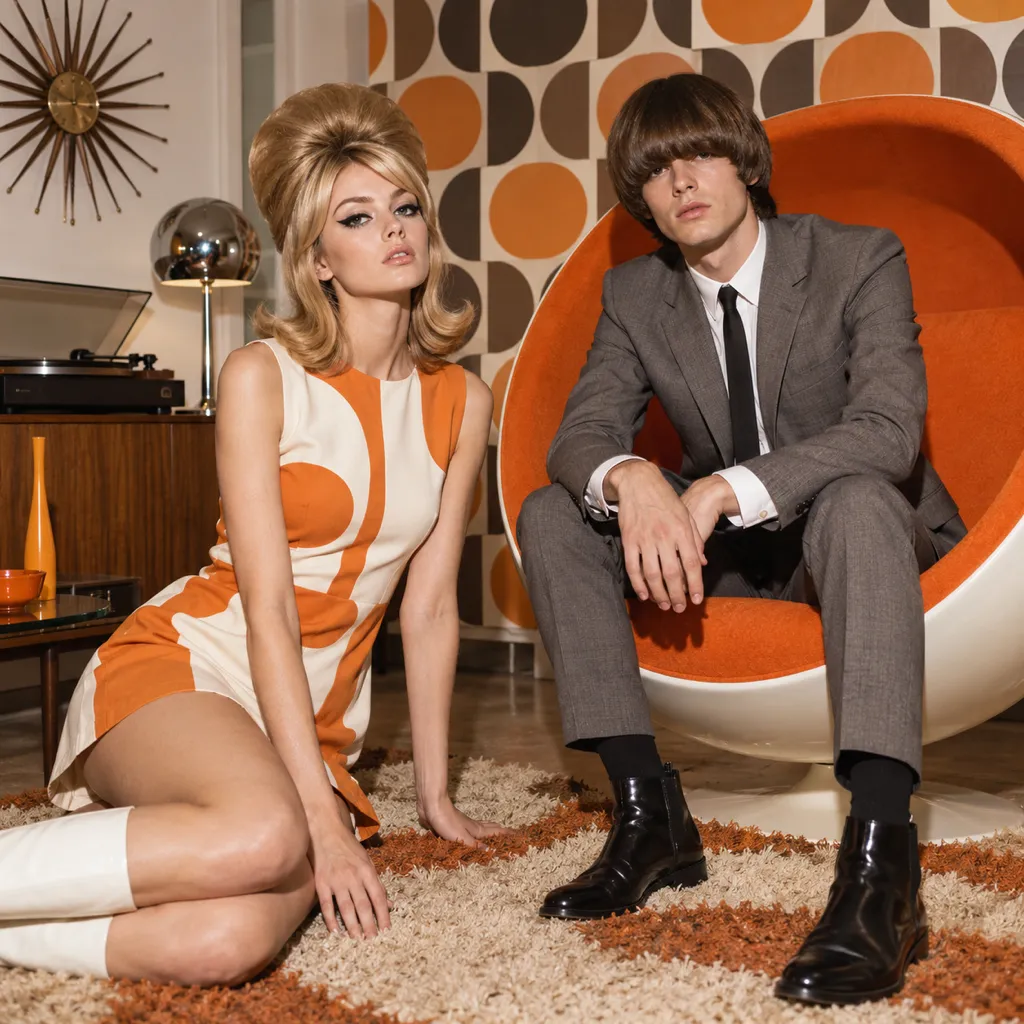
Hair in the 1960s
The 1960s cannot be reduced to one hair silhouette. Early-decade salon sets and tall bouffants coexisted with precise short cuts, while later youth styles often favored longer, less formally dressed hair. Fashion boutiques, popular music, television, and magazine photography helped circulate these alternatives. A geometric bob depended on cutting accuracy; a beehive depended on a constructed internal shape. They represented different uses of skilled hair work, not simply a choice between styled and unstyled hair.
Natural Black hairstyles also gained cultural and political visibility, challenging the idea that straightened hair was the necessary standard of grooming. These histories require attention to the wearer and setting rather than treating texture as a costume accessory. For a production, decide which part of the decade you are representing and study its specific community. A 1962 office, a mid-decade music club, and a late-decade student gathering need not share the same hair vocabulary.
Women’s signature styles
Beehive and high bouffant
Tall dressed hair became a recognizable early-1960s silhouette. A beehive concentrated the hair upward into a more contained shape, while bouffant styles could spread fullness more broadly. The terms overlap in casual use, but the position of the volume is important for costume design.
How it was done: Roller setting created a foundation with lift and bend. Backcombing built internal support, over which an outer layer was smoothed; pins and lacquer held the arrangement. Added hair or padding could supplement the wearer’s own length, making the finished outline larger than the haircut alone would suggest.
Recreating it for stage & costume: Build height on a secure wig foundation and use lightweight padding when appropriate. Keep the exterior smooth while leaving enough flexibility for movement. Check doorways, hats, microphones, and quick-change choreography during fitting; a convincing high style still has to let the performer work comfortably throughout the scene.
Geometric bob
Precise geometric cutting became strongly associated with the modern fashion image of the decade. Angular outlines and deliberately shaped perimeters offered a different effect from a teased salon set. Not every short bob was a five-point cut, and a period reference should determine the actual outline.
How it was done: Careful sectioning and scissor work created a shape intended to move as a coherent cut. The hair was smoothed and directed so the perimeter remained visible. The effect relied heavily on texture and cutting structure, with less need for the internal backcombing used in a bouffant.
Recreating it for stage & costume: Choose a wig that can hold a clear edge and examine it at the nape and temples. Do not merely straighten a heavily layered wig and expect a geometric silhouette. For a performer with textured hair, agree on a suitable wig or styling approach rather than assuming permanent alteration is necessary.
Flip with crown volume
An outward turn at the ends offered a lively contrast to a smooth or lifted crown. The flip could accompany shorter hair or a length approaching the shoulders. Its proportions varied, so the amount of teasing and the width of the ends should be read from a dated example.
How it was done: Rollers and setting lotion established body, with the lower sections directed to turn outward. Brushing organized the set, and selective backcombing could lift the crown. Hairspray preserved the final shape without replacing the underlying work of the set.
Recreating it for stage & costume: Prepare the ends with rollers or a modern heated tool, then brush them into a shared line. Keep the crown and perimeter in proportion: a very wide flip with excessive height can become a caricature. Test collar contact and retain a continuity photo showing both the front and the back.
Men’s signature styles
Mop top
The rounded mop top became closely associated with youth and popular music. Hair over the forehead and ears offered a noticeable contrast to short, exposed-ear barber cuts. Length and shape changed through the decade, so one early music-group photograph cannot represent every later version.
How it was done: Scissor cutting retained length around the head and across the front, producing a connected, rounded outline. Brushing directed the hair forward and down rather than slicking it off the forehead. Natural texture affected whether the finished shape appeared smooth, slightly waved, or fuller at the sides.
Recreating it for stage & costume: Avoid a rigid novelty bowl wig. Adjust the perimeter around the ears and forehead to the chosen year, leaving believable movement. If the wig is too dense, have it shaped by someone familiar with theatrical hair so the performer’s face remains visible without destroying the characteristic outline.
Conservative short side part
Short side-parted cuts remained present throughout the decade, particularly in settings where conventional grooming was expected. Their persistence makes them useful for showing generational and occupational contrasts. Fashion change did not mean that older or more conservative styles disappeared from ordinary life.
How it was done: The sides and back were tapered, with enough top length to part and brush across. Grooming cream or a light pomade controlled the finish. The front could have a small lift, but the overall shape stayed compact rather than covering the ears in a rounded curtain of hair.
Recreating it for stage & costume: Use a natural-looking taper and a modest finish. Compare sideburn length and the exposed area around the ears with the reference, since these details help place an otherwise familiar cut. Vary the part and texture across an ensemble to avoid making every conservative character look identical.
Natural Afro
The Afro gained visibility during the 1960s within Black cultural and political movements and was worn by women as well as men. Its significance could include pride in natural texture and resistance to restrictive beauty standards. Individual motivations varied, and the style should not be used to assign a political identity automatically.
How it was done: Tightly curled or coiled hair was worn in its natural texture and shaped into a rounded outline. Picking, combing, and careful trimming organized the silhouette, while grooming routines managed moisture and tangling. Natural hair required care and shaping; natural did not mean untouched or unmaintained.
Recreating it for stage & costume: Work with a stylist experienced in the performer’s texture and consult references from the specific setting. If a wig is needed, match density, coil pattern, and hairline rather than selecting an oversized novelty shape. Respect the performer’s existing hair and plan gentle preparation, removal, and maintenance through the run.
Notable products & tools
- Rollers, hood dryers, teasing combs, hairpins, and lacquer built volume and held dressed shapes. The smooth outer surface often concealed a substantial amount of internal support.
- Precision scissors and combs shaped geometric cuts, while picks and texture-aware grooming maintained natural silhouettes. Different looks required different routines rather than one standard salon method.
Regional & cultural variations
London Mod imagery, US suburban salon styles, Black freedom movements, and later counterculture each contributed distinct visual languages. Women also wore Afros, and longer men’s hair did not always signal the same beliefs. Build the cast from local, dated references and the script’s social world. Pay particular attention to the early-versus-late decade divide, while allowing characters to retain habits acquired in earlier years.
See it on your own face
Try a hairstyle free with one selfie. Explore a modern interpretation of a cut; the preview is a starting point for your design, not a historical reconstruction.
Sources & further reading
These museum, archive, library, and editorial resources provide historical context and further research. The stage and costume suggestions above are modern interpretations. Consult dated images for a specific year, place, and wearer.
- 1960-1969. Fashion History Timeline (FIT). https://fashionhistory.fitnyc.edu/1960-1969/
Overview essay on 1960s fashion, from Mod and the miniskirt to the hippie look.
- A '60s Fashion History Lesson: Mini Skirts, Mods, and The Birth of Boho. Vogue. https://www.vogue.com/article/1960s-fashion-history-lesson
Vogue's survey of 1960s style, covering Mod, the miniskirt and early boho.
- Introducing Mary Quant. Victoria and Albert Museum (V&A). https://www.vam.ac.uk/articles/introducing-mary-quant
V&A introduction to Mary Quant, the designer at the centre of the 1960s Swinging London look, from jersey minidresses to PVC.
- The miniskirt myth. Victoria and Albert Museum (V&A). https://www.vam.ac.uk/articles/the-miniskirt-myth
V&A curators trace the miniskirt's real history through surviving garments and period photographs.
- Vidal Sassoon: 10 of your cuts. BBC News. https://www.bbc.com/news/magazine-18100908
BBC readers' photos and memories of Vidal Sassoon's geometric cuts, including the 1960s five-point bob.