History, technique, and costume notes
1970s Hairstyles
Feathered movement, layered shags, natural volume, and braided patterns.
How to cite this page
HairstyleAtlas. “1970s Hairstyles.” https://hairstyleatlas.com/historical-hairstyles/1970s. Accessed October 20, 2026.
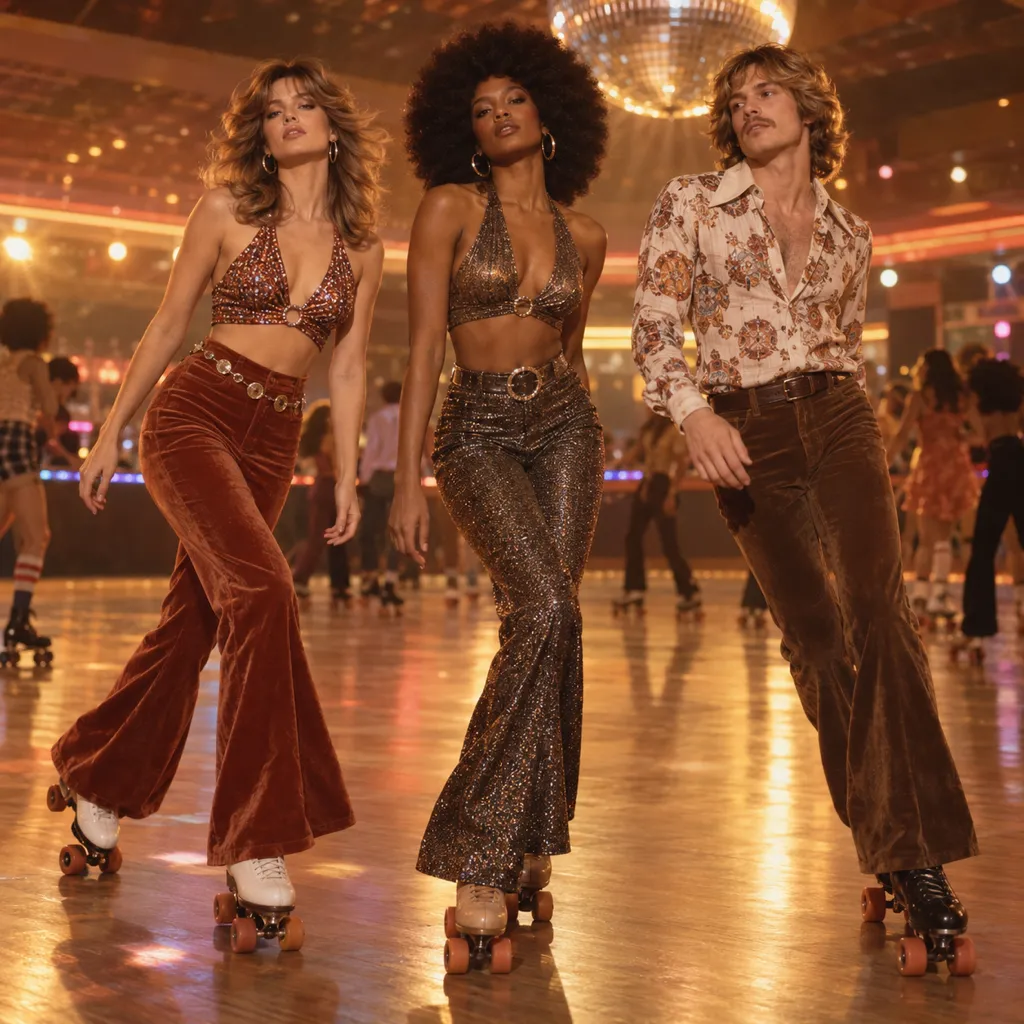
Hair in the 1970s
The 1970s made room for many competing silhouettes: feathered layers, full Afros, long center parts, layered shags, and the deliberately disruptive styling of punk. Music and youth culture circulated looks, but ordinary work and family photographs show a wider range than a disco retrospective. Blow-drying made a moving, brushed shape possible without reproducing the fixed surface of an earlier set. At the same time, many wearers continued to set, press, braid, or perm their hair.
Black natural hair and braiding traditions were central to the decade’s visual culture, with histories extending far beyond it. The Kenyan photographs listed below are useful evidence that the story is not confined to US and European fashion capitals. When designing a costume, identify whose fashion history you are representing. A hairstyle worn for daily life, political expression, a concert, or an evening at a club can carry different meanings even when its outline looks similar.
Women’s signature styles
Feathered layers
Long, face-framing layers brushed away from the face became especially recognizable in later-1970s popular imagery. The cut created overlapping lengths rather than a single heavy edge. Its movement was as important as its still silhouette, which is why the shape can look different in publicity portraits and candid photographs.
How it was done: Layering reduced weight, while a blow-dryer and brush directed sections outward and back. Rollers could reinforce the curve before brushing. A light holding product preserved lift without locking every section into a solid mass, allowing the ends to separate into a feathered outline.
Recreating it for stage & costume: Use a layered wig with enough length around the face to form outward curves. Brush the sides away from the cheeks and let the shape cool before dressing. Rehearse movement, since excessive spray can turn a flowing style into a stiff shell that looks wrong as soon as the performer turns.
Layered shag
The shag used layers to create a broken, less uniform outline, often with bangs and a longer nape. It crossed gender categories and appeared in different lengths. A modern wolf cut may share some features, but its proportions should not be assumed to reproduce a particular 1970s haircut.
How it was done: Scissor or razor cutting created shorter upper layers and longer lower sections. Blow-drying, brushing, or natural drying brought out movement according to texture. The effect depended on the distribution of weight through the cut, not simply on making a conventional long hairstyle look untidy.
Recreating it for stage & costume: Choose a reference showing the side and back, then shape the wig’s crown and nape accordingly. Avoid adding random choppy ends to a blunt wig. Keep the styling light enough for the layers to move and check that bangs remain manageable during dialogue, dance, and repeated quick changes.
Rounded Afro
The Afro continued the visibility it had gained in the previous decade and appeared across political, everyday, and entertainment settings. Women wore compact and expansive versions, shaped by texture, preference, and local fashion. No single diameter or outline can stand for all Black women’s hair in the 1970s.
How it was done: Coiled hair was carefully detangled, picked, and shaped to create the chosen outline. Trimming controlled the perimeter, while appropriate grooming maintained the hair’s condition. The finished volume reflected natural texture and preparation rather than a universal cutting formula.
Recreating it for stage & costume: Consult the performer and a stylist experienced with their texture before selecting a method. Match a wig’s coil pattern, density, and hairline to the design. Avoid comic exaggeration and give the same attention to continuity, fit, and maintenance that you would give a precision-cut or formally dressed wig.
Cornrows
Cornrows are scalp-close braids with much older African and diasporic histories. Their visibility in 1970s fashion should not be described as their invention or attributed to a later celebrity appearance. Patterns, lengths, and adornment varied between individuals and communities.
How it was done: Hair was sectioned into planned paths and braided close to the scalp, incorporating more hair as each braid progressed. The pattern depended on clean sectioning and skilled handling. Beads or other ornaments could be added where appropriate, but they were not an obligatory feature of every cornrow style.
Recreating it for stage & costume: Work with a braider and use a documented pattern suitable for the character. Plan the time required for fitting and avoid excessive tension or heavy ornaments. For a short run or frequent changes, discuss a professionally prepared wig; do not treat a culturally specific hairstyle as a generic decorative texture.
Men’s signature styles
Men’s shag
Layered men’s hair could cover the ears and extend at the nape while remaining lighter around the crown. Rock imagery helped circulate this outline, but it also entered ordinary fashion. Variants ranged from softly brushed shapes to more irregular, visibly separated layers.
How it was done: The cut established graduated lengths, often with bangs or a swept front. Brushing and blow-drying directed the layers, while natural wave supplied additional movement. The nape and sideburns contributed to the complete outline and should be considered part of the style.
Recreating it for stage & costume: Use profile references to set the balance between crown fullness and nape length. A current cut with very short sides will not automatically read as a period shag. Keep the finish appropriate to the character’s scene rather than making every version look like a carefully groomed album photograph.
Men’s Afro
Afros were visible in Black everyday life, sport, music, and political culture. Their meanings differed among wearers and changed with setting. A rounded natural silhouette was one choice among many, not the only hairstyle worn by Black men during the decade.
How it was done: Picking and shaping organized the coiled hair into a balanced outline. Regular trimming could maintain the perimeter while grooming routines managed moisture and tangling. Density and growth pattern affected the finished shape, making individual care more useful than a fixed size prescription.
Recreating it for stage & costume: Choose the shape from the character’s references and collaborate with a texture-experienced stylist. A modern sharply lined taper is a different design decision from a fuller period outline. If using a wig, check the nape, temples, and density under stage light rather than assessing only its front silhouette.
Long center-parted hair
Long men’s hair continued from late-1960s counterculture into a broader range of 1970s settings. It could still provoke disagreement over respectability, work, or gender expectations. The same length might be styled smoothly for one wearer and left with visible natural wave for another.
How it was done: Hair was grown beyond conventional short barber lengths and divided near the center. Brushing, drying, and occasional trimming controlled the outline. A smooth finish might involve blow-drying, while other wearers allowed the hair’s own texture to determine how it fell.
Recreating it for stage & costume: Select a length that works with the collar and movement in the scene. Give a wig a believable part and avoid an unnaturally dense hairline. Distress or loosen the finish deliberately when the story calls for it, while keeping the performer’s view clear and the wig securely fitted.
Notable products & tools
- Blow-dryers, round brushes, and rollers could create outward movement in layered hair; the haircut supplied the structure that those tools emphasized.
- Picks, sectioning combs, and braiding skill supported natural and braided styles. Conditioning and careful handling were part of maintenance, not evidence that natural hair was somehow unstyled.
Regional & cultural variations
Disco, glam, punk, soul, office dress, and regional everyday fashion overlapped without becoming one uniform look. The Mohamed Amin archive shows Kenyan interpretations of contemporary fashion, while the Victorian archive offers an Australian perspective on men’s changing hair. Braids and Afros also crossed gender categories. Identify a character’s community and circumstances before assigning a style, and treat modern recreation advice as a practical interpretation rather than a claim about every historical wearer.
See it on your own face
Try a hairstyle free with one selfie. Explore a modern interpretation of a cut; the preview is a starting point for your design, not a historical reconstruction.
Sources & further reading
These museum, archive, library, and editorial resources provide historical context and further research. The stage and costume suggestions above are modern interpretations. Consult dated images for a specific year, place, and wearer.
- 1970-1979. Fashion History Timeline (FIT). https://fashionhistory.fitnyc.edu/1970-1979/
Overview essay on 1970s fashion, from disco and glam to punk, with dated images.
- A 1970s Fashion History Lesson: Disco, Denim, and the Liberated Woman. Vogue. https://www.vogue.com/article/1970s-fashion-history-lesson
Vogue's survey of 1970s style, from disco glamour to denim.
- In Vogue: 1970s Kenyan Fashion. Mohamed Amin Foundation via Google Arts & Culture. https://artsandculture.google.com/story/in-vogue-1970s-kenyan-fashion-mohamed-amin-foundation/-AXxqpvx-XOqSA?hl=en
Archive photographs of 1970s Kenyan street style, including the Afro and shag hairstyles of the decade.
- Hair: From Mos to Mullets. Public Record Office Victoria via Google Arts & Culture. https://artsandculture.google.com/story/0QUxGFj7MQ8aIw?hl=en
Archival story on men's hair and facial hair, including how long hair moved from protest to mainstream by the late 1970s.
- Punk to Pop. Victoria and Albert Museum (V&A). https://www.vam.ac.uk/exhibitions/punk-to-pop
V&A exhibition page on music and fashion from 1972 to 1985, covering punk's influence on dress and hair.