Shag Haircut: How to Ask for One, by Length and Hair Type
Oleh Onysko Updated 28 September 2026 17 min read
In this article
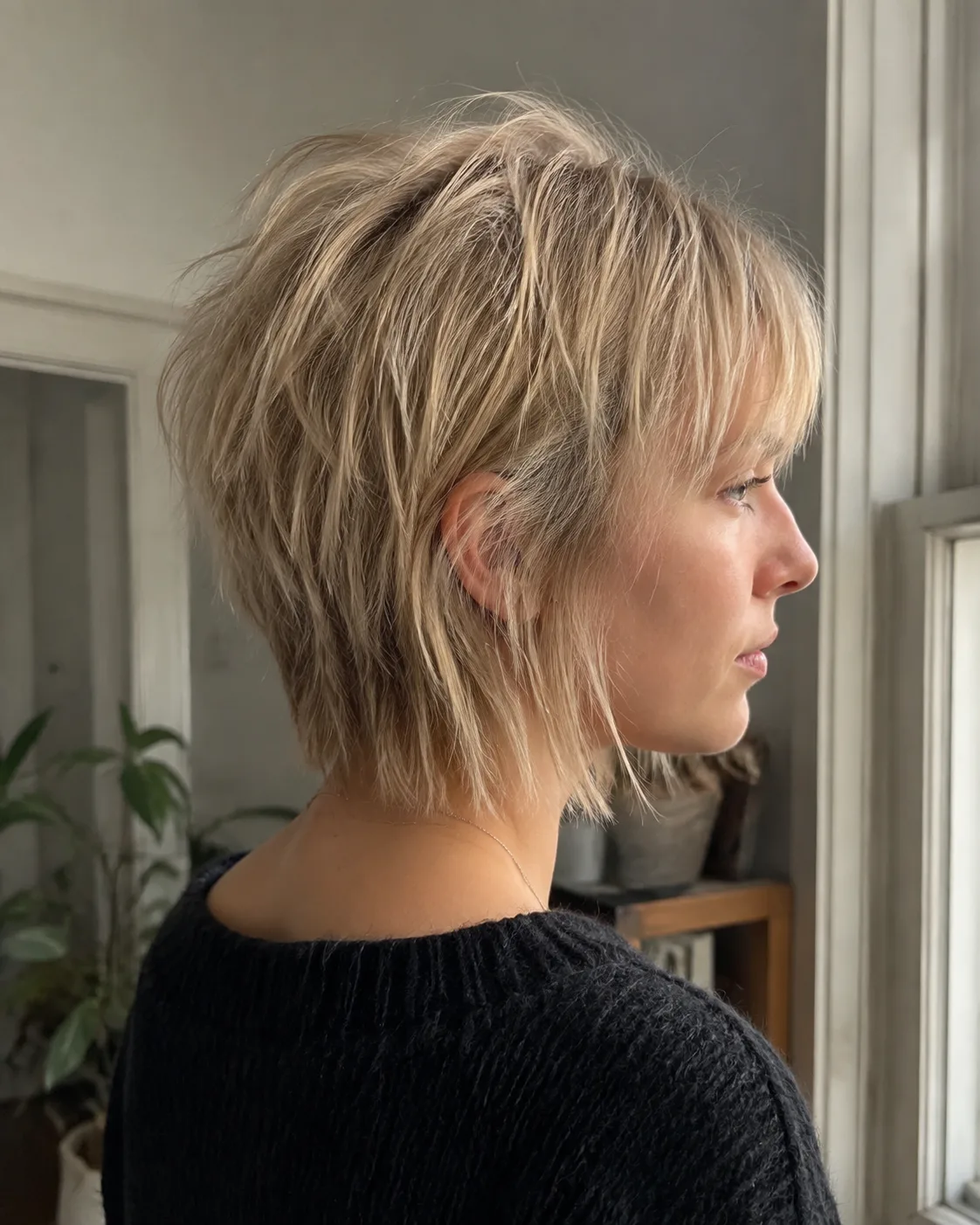
A shag takes weight out of the middle of your hair, not off the ends. Short interior layers start at the crown and finish above your perimeter length, the ends are cut into points instead of straight across, and a fringe ties the shape to your face.
That last part is where most people lose the haircut they wanted. A shag is not layers added to your hair. It is hair removed from the inside of it. Which is why a shag makes fine hair look like there is more of it while leaving less of it on your head, and why the same cut can turn thick coarse hair into a pyramid.
Ask for "layers" and you get a layered cut that hangs. Ask for a shag properly and you get width high on your head and almost nothing left in the bottom corners.
Below: the exact words to say in the chair, which shag matches your length and your hair type, eight builds worth screenshotting, and the four ways it goes wrong.
What a shag haircut actually is
Three things have to be true at once. Miss one and you own a different haircut.
- Short interior layers from the crown down. The shortest pieces sit near the top of your head, not hidden underneath at the nape. That is what puts the width up high.
- Point-cut ends. The perimeter is cut into at an angle so it breaks into separate pieces. A blunt line at the bottom is the opposite of a shag.
- A fringe that connects. Brow-skimming, curtains, or something grown out and split. It has to join into face-framing pieces down your cheekbones instead of sitting on your forehead as its own block.
The cut is usually credited to New York stylist Paul McGregor, who gave it to Jane Fonda around 1969 and sent it worldwide with the 1971 film Klute. Wikipedia's description of the mechanics has not needed updating since: the layers make the hair full around the crown, and the hair thins to fringes around the edges.
What did change is the finish. A 1970s shag was blow-dried and combed out into one soft halo. The version people ask for now is air-dried, matte and deliberately undone. Same cut, opposite styling. Worn at chin length with heavy bangs, it is also one of the most requested short lesbian haircuts right now. The shag was only one of the cuts that defined the decade, and our guide to 70s hairstyles sets it beside the Farrah flip, the wedge and the afro.
Shag vs layers vs wolf cut
These three names get used as if they mean the same thing. They do not, and a stylist who hears one when you meant another hands you the wrong haircut.
| Where the weight goes | Perimeter | Fringe | Reads as | |
|---|---|---|---|---|
| Layered cut | Weight stays in, layers follow the shape you already have | Blunt or softly tapered, one clear line | Optional | Smooth, one mass with movement |
| Shag | Weight cut out of the interior, from the crown down | Broken and piecey, no line | Almost always | Full at the top, wispy at the ends |
| Wolf cut | Same as a shag but pushed harder, plus disconnection at the back | Short on top, longer tail at the back | Heavy | A shag crossed with a mullet |
If the broken perimeter is the part that puts you off, the answer is usually a layered bob, which keeps one clean line and hides the weight removal inside it.
The fringe on a shag is almost always the undone kind, so if that is the part you actually want, read how a messy fringe is cut before you book the whole shag.
Push the disconnection at the back all the way to a hard blunt line and you have left the shag family entirely: that is the jellyfish haircut, where the top section stops dead and the long hair carries on underneath it. Before you commit to a line that hard, you can test the shape with a hair tie and see it on your own head first.
The practical difference: a layered cut still looks finished when you brush it smooth. A shag looks wrong brushed smooth, because the separation between the pieces is the haircut.
Which shag fits your length
Length changes what the cut does for you, not just how it looks.
| Length | What it does | Best for | Watch out for |
|---|---|---|---|
| Chin to jaw | Maximum lift, most dramatic change | Fine hair, straight hair, anyone chasing volume | Grows out fast, needs a cut every 6 to 8 weeks |
| Shoulder to collarbone | The safest version, most movement per inch removed | Almost everyone, first-time shags | Goes flat at the crown if the layers start too low |
| Past the collarbone | Keeps your length, adds movement and a fringe | Long hair you do not want to lose, wavy hair | Goes triangular on thick hair unless weight comes out low too |
One caveat on the wavy row: a shag is calibrated for waves that hold their own shape, so if yours are the loosest kind you will want the lighter layering described in the guide to 2A hair rather than a full shag.
Short shag

A short shag stops between the chin and the jaw, with the interior cut close enough that the crown stands up on its own. This is the version that changes fine hair the most, because the shorter the hair, the less weight there is dragging the root flat.
It also has the shortest grace period. Six weeks in, the interior grows into the perimeter and the shape softens. Ten weeks in, it is a slightly messy bob. If you cannot commit to a cut every two months, take the shoulder-length version instead.
Shoulder-length shag
If this is your first shag, get this one. The interior layers have room to stack without leaving you nothing to tie back, and it works on straight, wavy and curly hair with no change beyond how the fringe is cut. This is also the length that shows up most often when people search shag haircut shoulder length, and there is a reason for that. For the other cuts that work at this length, see ten shoulder length cuts matched to hair type.
The one thing to specify: where the shortest layer starts. Ask for the interior to begin at the crown. Start it down at the ears and the top stays heavy, which loses the whole point of the cut.
Long shag

The long shag is how you keep length and still get movement. Layers run from the crown to the ends, the fringe does most of the work around your face, and the length below your shoulders barely changes. It sits at the interesting end of the long hair options because it is the only one that reshapes without shortening.
The failure here is the triangle. Long hair, plus interior layers, plus no weight taken out near the ends, equals a shape that is narrow at the top and wide at the bottom. Ask specifically for the ends to be point-cut and thinned, not just layered above.
Which shag fits your hair type
This is where the cut earns its reputation, and where it gets people into trouble.
| Hair type | Verdict | The adjustment to ask for |
|---|---|---|
| Fine and straight | Best cut on this list | Keep the perimeter fairly solid, layers short and stacked high, do not thin the ends |
| Medium and wavy | Made for it | Cut it dry so the stylist can see where the wave falls |
| Thick and coarse | Works, with care | Take weight out low as well as high, or it goes pyramid |
| Curly, 3a to 3c | Works beautifully | Cut curl by curl, dry, no razor on tight curl |
| Very straight and heavy | Hardest case | Needs the most interior removal, and it will still drop by day three |
Fine hair
Here is the part that sounds backwards. Cutting hair away makes fine hair look like there is more of it. A blunt one-length cut puts every strand in the same place and the eye reads one thin sheet. Break that into layers of different lengths and the eye reads depth instead.
The mistake is going too far. If your stylist thins the ends of fine hair with a razor or thinning shears, the perimeter goes see-through and the cut looks sparse from three feet away. On fine hair the ends stay reasonably solid and the work happens in the interior. Say that out loud, because thinning the ends is the default move.
Curly and wavy shags

A shag on curly hair is close to the ideal use of the cut. The curl already gives you separation, and the layers just give it somewhere to go. One rule matters more than everything else: it has to be cut dry, curl by curl. Wet curly hair is a different length from dry curly hair, and a stylist cutting wet takes too much every time.
If your texture is tighter than a 3c, read the 4c hair guide before you book, because the shape gets built differently.
Which shag fits your face shape
A shag suits more face shapes than most cuts, and the reason is simple: you can move where the shortest face-framing piece lands. That one choice does most of the work.
- Round face. Keep the shortest face-framing piece at or below the jaw, and split the fringe rather than leaving it solid. Length past the collarbone with a long curtain fringe is the safest build.
- Long or oblong face. A fringe is not optional. A brow-skimming fringe shortens the face. A centre-parted curtain lengthens it, which is the wrong direction here.
- Square face. Soft wispy face-framing pieces starting at the cheekbone, to break up the jaw line. Avoid a blunt chin-length perimeter.
- Heart face. Keep the weight lower, so leave the interior layers a little longer and let the fringe be wide rather than narrow.
Measure before you guess. Most people are wrong about their own face shape, and the fringe decision rides on it.
Measure it instead of guessing
Both numbers in the same unit — the answer is a ratio, so it does not matter which.
Under 1.15 reads round, 1.15 to 1.5 reads oval, over 1.5 reads long. Oval and long split on the jaw rather than the ratio: an oval tapers toward the chin, a long face runs straight down.
8 shag haircuts to take to your appointment
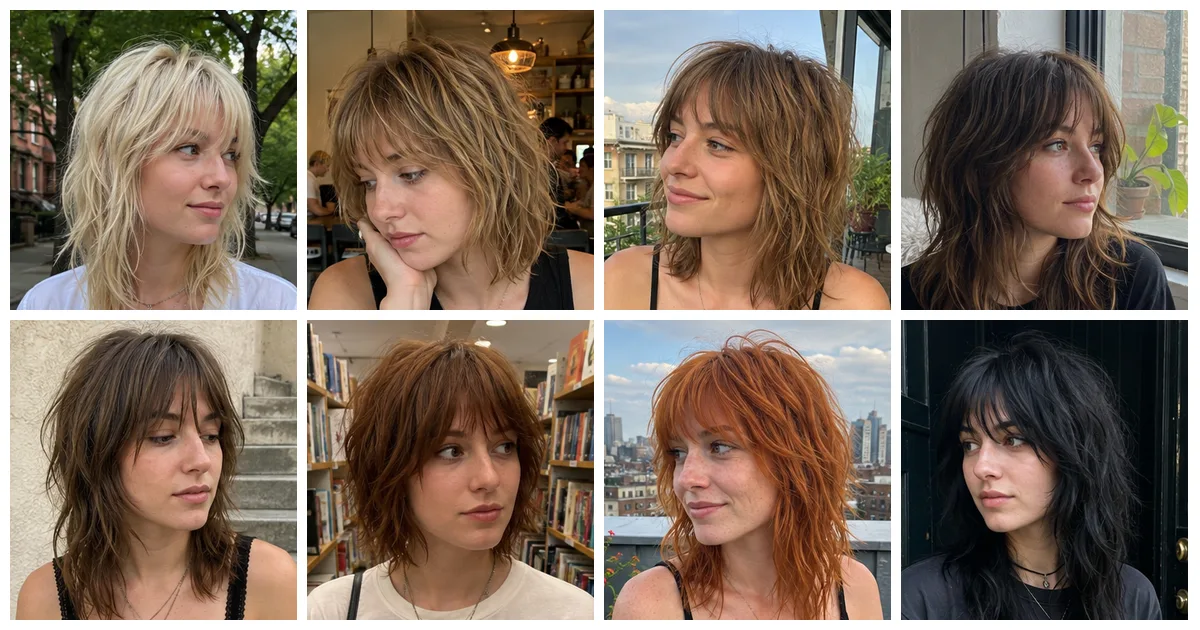
One cut, eight builds. What changes down this list is only the perimeter length and the texture it is cut into, so find the tile closest to your own hair and say "this one, on my hair".
Gallery8 photos · tap to enlarge
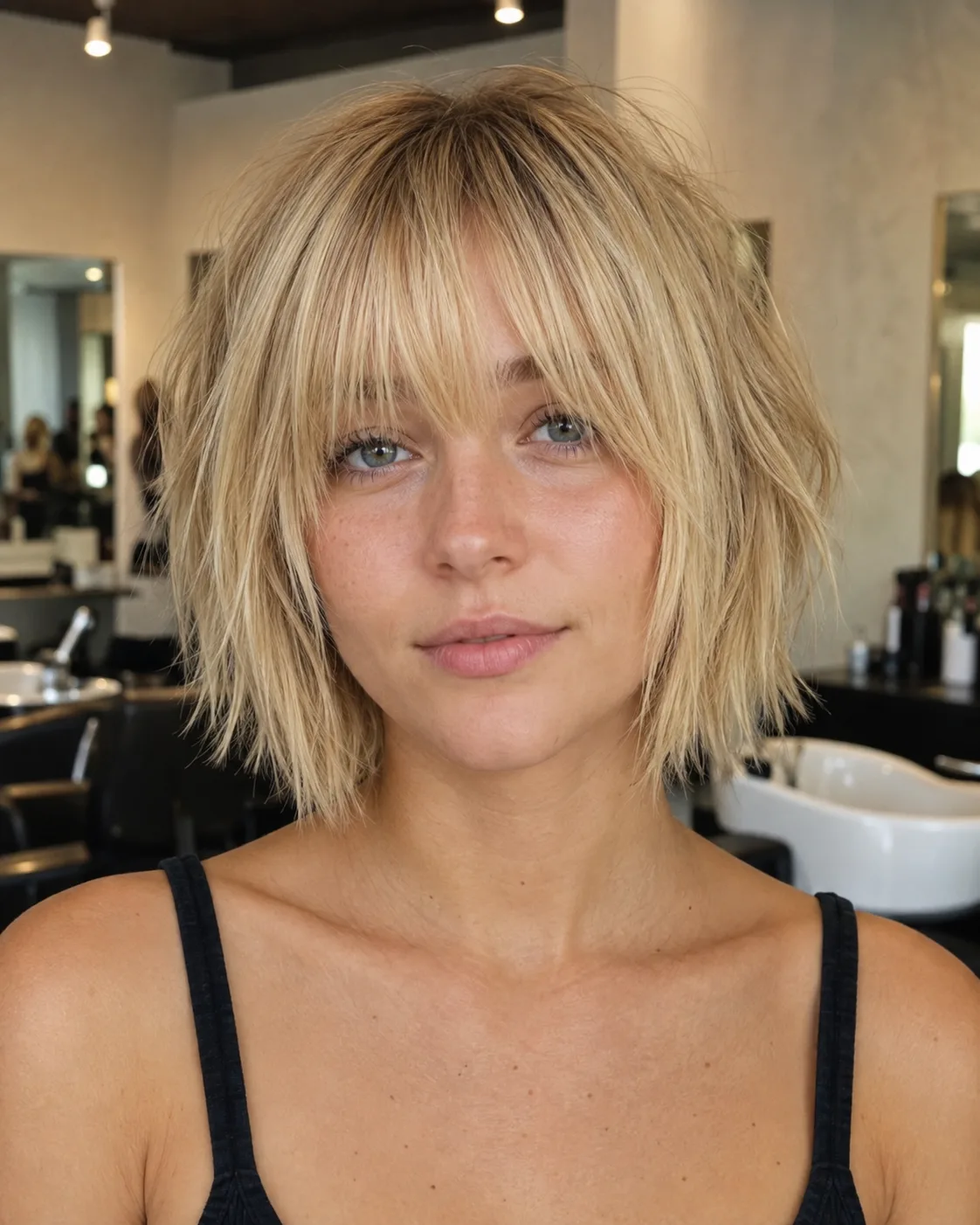 Try this on me
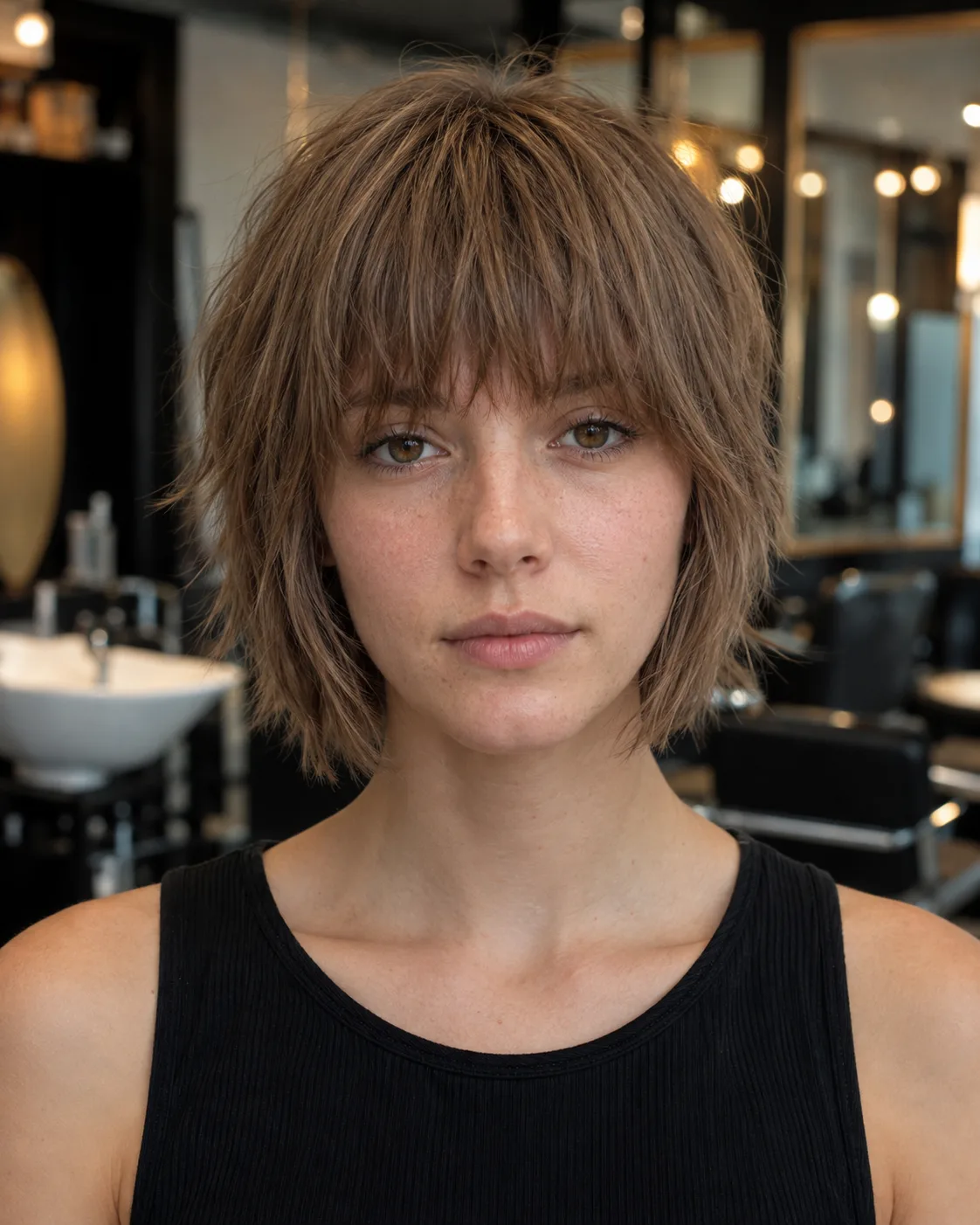 Try this on me
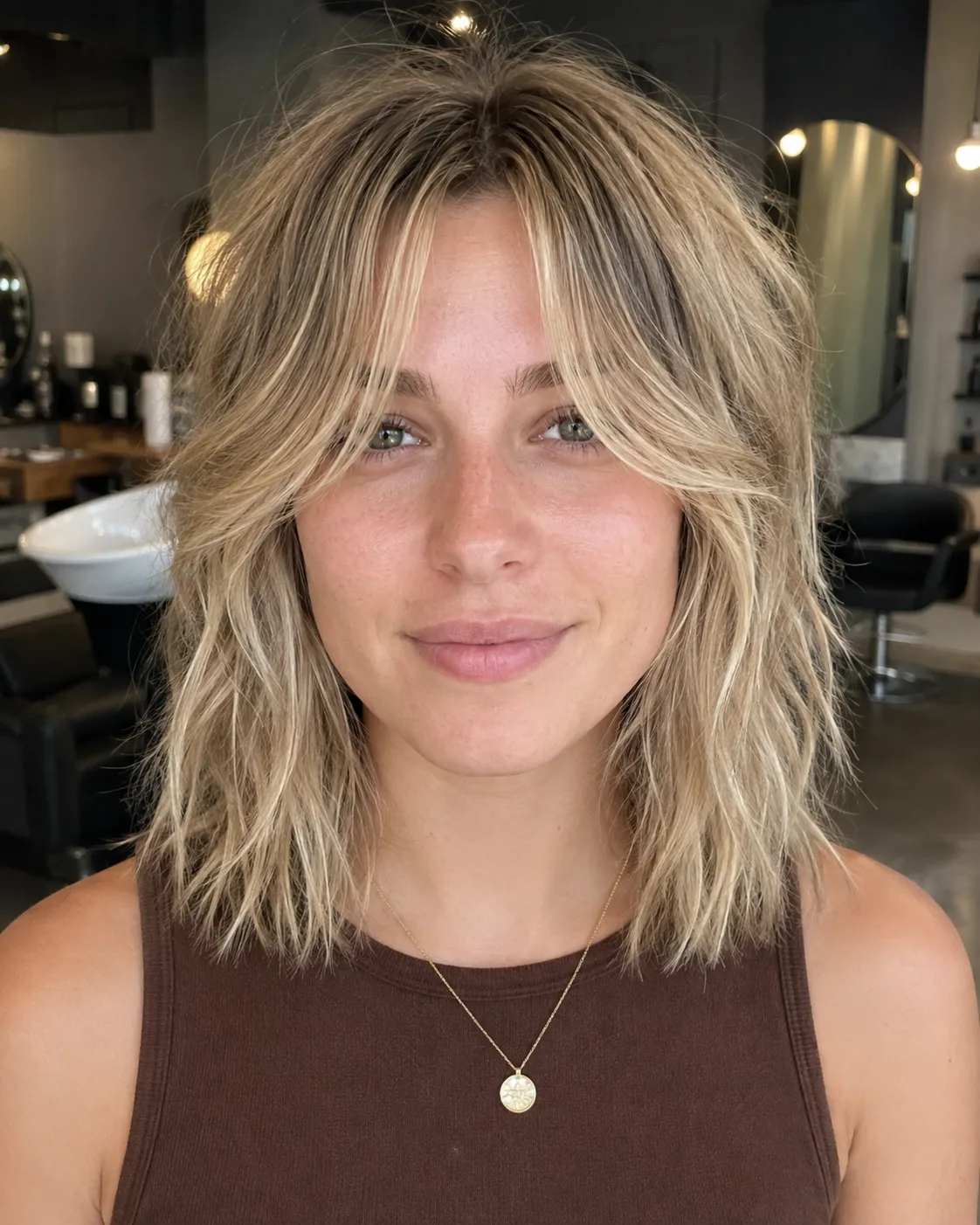 Try this on me
 Try this on me
 Try this on me
 Try this on me
 Try this on me
How to ask for a shag
Read this off your phone. It is short on purpose, because the specifics matter more than the adjectives.
Say this to your barber
I want a shag. Start my shortest interior layers at the crown so the weight comes out of the top, keep the perimeter at collarbone length, point-cut the ends so they stay piecey, and cut me a soft fringe that connects into face-framing pieces at my cheekbones.
Then add one line for your hair:
- Curly or wavy: "cut it dry, please."
- Fine: "leave my ends fairly solid and take the weight out of the interior instead."
- Thick: "take weight out near the ends too, I do not want it going triangular."
And ask one question before the first cut: how short is the shortest piece going to be? A shag's shortest interior layer can be anywhere from two inches to five. Getting the number out loud removes the surprise. If you want the fringe worked out first, the textured fringe guide covers the versions worth naming.
Yours could be here.
Start with one selfie.
One photo, twenty seconds, and you'll know. Free account, no card for your first render.
Four mistakes that ruin a shag
Saying "shaggy layers" instead of "a shag". Those two phrases point at different haircuts. "Shaggy layers" gets you your current shape with texture added, and you will be back in three weeks wondering why nothing moves.
Getting it cut wet on curly or wavy hair. Wet hair hangs, dry hair springs. A shag cut wet on a wave comes out one to three inches shorter than you agreed to, and nothing fixes that except time. The spring is biggest on loose spirals, so if you are somewhere around the 3a mark, insist on a dry cut.
Skipping the fringe. A shag without a fringe is a layered cut. The fringe is what connects the interior shape to your face, and it is the part that makes the cut read as a shag in a photograph.
Brushing it. A shag styled smooth looks like a haircut that went wrong. The separation between the pieces is the design. If you love what a round brush and a paddle brush do for your hair, a shag will fight you every morning.
How to style a shag so it looks like the photo
How to style a shag haircut
- Rough dry to 80 percent
Towel the water out, then dry with your head tipped forward and your fingers working at the root until it is nearly dry. No brush. The crown volume is decided here and nowhere else.
- Put product into damp hair, not dry
Texture spray, sea salt spray or a light mousse goes in while there is still a little damp left. On dry hair it sits on the surface and turns crunchy.
- Break the fringe with your fingers
Push the fringe forward, then split it with your fingertips into two or three pieces. Never comb it flat.
- Bend the ends, do not curl them
If you use heat, take one-inch sections and bend them in alternating directions with a flat iron or a large barrel. Alternating is the whole point. All in one direction reads as a blow-dry, not a shag.
- Finish at the root, not the ends
A pinch of dry shampoo or root powder at the crown, then stop. Every extra product on the ends pulls the pieces back together, which is the one thing you are trying to avoid.
That is five minutes on day one and about one minute on day two, which is when a shag actually looks best.
Can you see a shag on yourself before you book
Yes, and the free method is worth doing first.
Pull four or five photos of shags at your length and your hair type, hold your phone up beside a mirror in daylight, and cover the model's face with your thumb so you are only judging the shape around the head. This catches the obvious mismatches, and ten minutes of it beats an appointment you cannot undo.
Where it stops working is your own face. You cannot see your own head in profile, and the fringe is the most face-dependent decision in the cut. That is the wall the mirror trick hits.
Hairstyle Atlas renders the cut onto your own photo instead. The first look is free and needs no card. After that, plans start at $9 a month or $90 a year, with a seven-day refund that has no conditions attached. The women's try-on covers shag lengths and fringes, and there are separate pages for bangs and for the wolf cut if that is the version you are weighing up.
The one thing to remember
A shag is weight removed from the inside of your hair, and every good thing about the cut follows from that. Fine hair looks fuller because the mass is broken up. Thick hair goes triangular when the weight only comes out of the top. Curly hair works best because the separation is already there.
So do not ask for layers. Ask for the shortest interior layer to start at the crown, the ends to be point-cut, and a fringe that connects. Three specifics, and you get the haircut in the photograph.
Frequently asked questions
A layered cut keeps the weight in your hair and cuts layers that follow the shape you already have, so it still reads as one mass. A shag removes weight from the interior, starting at the crown, so the width sits high and the ends break into separate pieces. Brush both smooth and the layered cut still looks finished, while the shag looks like a mistake.
Yes, and it is one of the more durable trends on the board rather than a spike. That is the opposite of the sharper, more divisive shapes moving alongside it, where the trend itself is easy to misread from a feed. The shag has come back in some form in every decade since the 1970s, and the current version is the matte, air-dried, wolf-cut-adjacent build rather than the blow-dried 1970s halo. What changes is the styling, not the cut.
They are one of the best options for it. Fine hair looks thin partly because a blunt one-length cut puts every strand at the same place, and the eye reads a single sheet. Short interior layers stacked at the crown break that up and read as depth. The one rule: do not let anyone thin your ends with a razor or thinning shears, or the perimeter goes see-through.
Most of them, because you can move the shortest face-framing piece to suit. Round faces want that piece at or below the jaw with a split fringe. Long faces want a brow-skimming fringe to shorten the face. Square faces want soft wispy pieces from the cheekbone down to break the jaw line. Heart faces want the weight lower and the fringe wide.
Close, but not quite. The hardest case is very straight, very heavy hair, which needs a lot of interior removal and still drops flat by day three. The second hardest is anyone who wants a smooth, polished, brushed-out finish, because a shag is designed to look undone. If those describe you, a soft layered cut will make you happier.
Three. It needs cutting every 6 to 8 weeks at short lengths, because the interior grows into the perimeter and the shape disappears. It needs product and finger-drying every wash. And it is hard to reverse, since you cannot put interior layers back and you are waiting on growth for months.
Layered, in almost every case, as long as the layers come out of the interior and the perimeter is left reasonably solid. One length looks thicker on paper and thinner in a mirror, because the shape has no depth. The exception is hair that is both fine and very short already, where there is not enough length to layer without gapping.
Hair that is already damaged through the mid-lengths, because layers expose the broken ends instead of hiding them. Very thick coarse hair should not be layered from the top only, since that is what produces the triangle. And a bob you specifically want blunt should stay blunt, because layers and a hard perimeter line work against each other.
Preview it on your own photo: Virtual Hair Color Try-On.
Share article
About the author

More articles
Women's Haircuts · 14 min
Bleached Hair: How Light Yours Can Go, 14 Shades, Aftercare
How light your bleached hair can go depends on where it starts. See 14 bleached shades on one cut, what each starting color can reach in one session, how toner finishes the job, and the aftercare that keeps it soft.
Women's Haircuts · 16 min
Waves Hair: How to Get Beach, Loose and Hollywood Waves That Last
Waves hair is about what you leave straight. How to get beach, loose, Hollywood and heatless waves, which wave suits your hair type, and why your waves keep falling out.
Women's Haircuts · 15 min
Fino Hair Mask: Who It Suits, How to Use It, and Its Limit
The Fino hair mask makes dry, bleached and frizzy hair smooth and shiny in one use, mostly by coating it. Here is what is in the jar, which hair types it suits, exactly how to use it, and what to do when the ends are past a mask.